Plato’s Shadow: The Philosophical Seed
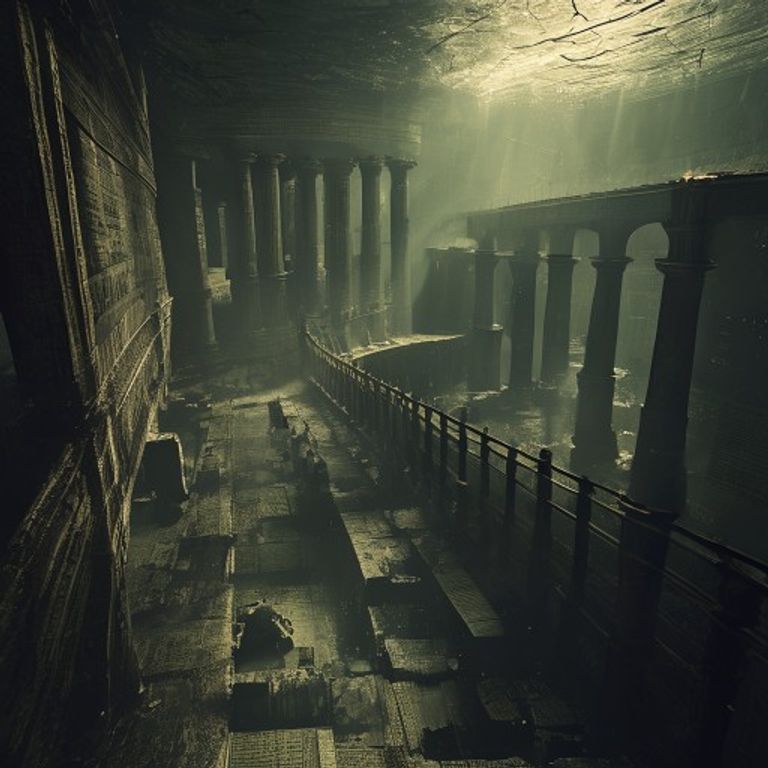
Plato’s account of Atlantis, presented primarily in his dialogues Timaeus and Critias, stands as the foundational text for the entire legend. Within these works, Atlantis emerges not as a historical chronicle but as a sophisticated philosophical device. Critias recounts a story passed down through generations, allegedly from Solon, who heard it from Egyptian priests. This narrative describes a powerful maritime empire, technologically advanced yet morally corrupt, which attempted to conquer Athens. A cataclysmic event, however, caused Atlantis to sink beneath the waves in a single day and night. For Plato, this tale served as a political allegory, contrasting an idealized, ancient Athens—a model of virtue and societal balance—with the hubris and ultimate downfall of the Atlantean empire. The myth thus functioned as a warning against imperial overreach and moral decay, embodying principles central to his broader philosophical teachings on justice and governance.
The immediate reception of Plato’s Atlantis in antiquity was varied, though it largely leaned towards viewing it as a literary creation rather than a factual report. Aristotle, Plato’s student, is famously cited as regarding the story as a fiction, stating that “he who invented it also destroyed it.” This perspective highlights a crucial understanding among many classical scholars: that Plato, a master storyteller and philosopher, employed myths and fables to convey deeper truths. While some later Neoplatonists, such as Crantor, might have pondered its potential historicity, their interest often stemmed from an attempt to reconcile Plato’s philosophical allegories with a deeper cosmological order, rather than a literal archaeological quest. The narrative’s dramatic power, combined with its cautionary message, cemented its place in philosophical discourse, even if its literal existence remained largely unexamined by rigorous historical inquiry.
Early commentaries focused on the allegorical weight, discussing the ideal state Athens represented and the moral lessons gleaned from Atlantis’s demise. Historians and geographers of the era generally remained silent on Atlantis, implying they found no corroborating evidence within their known world. This initial intellectual landscape saw Atlantis as a powerful piece of rhetoric, a philosophical tool to explore the nature of societies and the consequences of their actions, rather than a puzzle box demanding a physical solution. The subsequent centuries would, however, gradually shift this perception, allowing the philosophical seed to germinate into a full-blown historical enigma for later generations.
Renaissance Revival and Speculative Geographies
The rediscovery of classical texts during the Renaissance breathed new life into the Atlantis narrative, transforming it from a mere philosophical allegory into a subject of geographical speculation and utopian ambition. As European explorers ventured across the Atlantic, charting new lands and encountering previously unknown civilizations, the intellectual climate became ripe for considering the possibility of lost continents and forgotten histories. Plato’s description of a vast island beyond the “Pillars of Heracles” resonated strongly with the reality of newly discovered American continents, igniting a wave of theories that attempted to link Atlantis with the New World. Scholars like Francis Bacon, in his unfinished utopian novel New Atlantis (published posthumously in 1627), reimagined the Atlantean legacy not as a cautionary tale of hubris, but as a potential blueprint for an ideal society. Bacon’s Bensalem, a technologically advanced and scientifically enlightened island nation, deliberately invoked the spirit of Plato’s lost civilization, projecting an image of progress and discovery onto a mythical predecessor.
This period saw a blurring of lines between myth, philosophy, and nascent geographical science. Cartographers and antiquarians, grappling with the expanding world map, began to cautiously entertain Atlantis’s potential reality. While no definitive location was agreed upon, the sheer possibility fueled debates among the learned societies of Europe. The idea of a sunken land offered a compelling explanation for perceived gaps in historical knowledge or the shared cultural elements observed between distant peoples. It fed into a broader fascination with ancient wisdom and the potential for lost knowledge to re-emerge. The works of figures like Athanasius Kircher, a Jesuit polymath of the 17th century, exemplified this trend. His Mundus Subterraneus (1665) included a map depicting Atlantis as a large island in the Atlantic Ocean, based on Plato’s dimensions and placing it squarely in the realm of geographical possibility, even if his methods were largely speculative.
Kircher’s detailed maps and descriptions, though based on a literal interpretation of Plato rather than empirical evidence, lent a tangible, almost scientific, credibility to the Atlantis myth. He synthesized various ancient accounts and theories, positioning Atlantis as a crucial link in a grand, interconnected ancient world. This intellectual current diverged significantly from the ancient Greek philosophical view, pushing Atlantis into the domain of historical geography. The Renaissance fascination with grand narratives, coupled with the age of exploration, provided fertile ground for the myth to transition from a philosophical warning to a potential geographical antecedent for European expansion and a source of inspiration for ideal societies, profoundly influencing subsequent interpretations of the lost continent.
The 19th Century and the Occult Revival
The 19th century witnessed a dramatic transformation in the perception of Atlantis, largely driven by the burgeoning spiritualist and occult movements. As established religious dogma faced challenges from scientific advancements, many individuals sought alternative explanations for humanity’s origins and destiny, finding fertile ground in ancient myths and esoteric wisdom traditions. It was Ignatius Donnelly’s Atlantis: The Antediluvian World, published in 1882, that arguably solidified the myth’s modern form. Donnelly, an American Congressman and populist writer, meticulously compiled ethnographic, linguistic, and geological parallels between ancient civilizations across the globe, positing Atlantis as the common source of all culture and technology. He argued for its literal existence in the Atlantic, suggesting it was the Garden of Eden and the origin of virtually all human progress before its catastrophic destruction. His work, while largely dismissed by mainstream archaeology and geology, became a runaway bestseller, profoundly influencing popular imagination and setting the stage for more overtly spiritual interpretations.
Following Donnelly, the Russian mystic Helena Blavatsky, co-founder of the Theosophical Society, took the Atlantis myth to new, transcendent heights. In her monumental work The Secret Doctrine (1888), Blavatsky integrated Atlantis into her elaborate cosmological scheme of Root Races. She described the Atlanteans as a highly advanced, pre-human race with immense psychic powers, whose civilization spanned vast portions of the Earth before their eventual decline and destruction. Her account, purportedly derived from ancient occult texts and her own spiritual visions, presented Atlantis not merely as a lost continent but as a key stage in humanity’s spiritual evolution. This version of Atlantis resonated deeply with those seeking spiritual enlightenment and a connection to a lost, golden age of wisdom, offering a compelling alternative to conventional historical narratives.
Blavatsky’s mystical rendition of Atlantis moved the narrative far beyond Plato’s philosophical allegory or Donnelly’s quasi-scientific theorizing. It became embedded in a complex system of esoteric thought, linking it with concepts of reincarnation, karma, and cosmic cycles. Theosophy’s influence extended to various occult and New Age movements, ensuring that Atlantis remained a powerful symbol of hidden knowledge, forgotten powers, and humanity’s potential for both greatness and self-destruction. This period marks a pivotal shift, where the myth transitioned from being a matter of geographical speculation or historical curiosity to a central tenet within a broad array of spiritual and metaphysical beliefs, laying the groundwork for many contemporary appropriations of the legend. For a deeper look at specific historical searches, one might consider reading about some of the more elaborate quests outlined in articles like expeditions that sought physical evidence of Atlantis.
Edgar Cayce and the American Esoteric Tradition
The early 20th century saw the emergence of Edgar Cayce, the “Sleeping Prophet,” whose trance readings introduced a distinctly American flavor to the Atlantis myth, blending esoteric beliefs with a unique emphasis on spiritual healing and past lives. Cayce, while in an altered state of consciousness, provided thousands of “life readings” for individuals, often claiming to access the Akashic Records – a purported universal library of all human thought and experience. Within these readings, Atlantis frequently appeared as a significant past life for many of his clients. Cayce described a highly advanced Atlantean civilization, possessing technologies far beyond contemporary understanding, including powerful “firestones” or “great crystals” used for energy generation, healing, and even interdimensional travel. His visions painted a picture of a society that eventually succumbed to its own technological hubris and moral decline, leading to catastrophic destruction in several stages, the final one occurring around 10,000 BC.
Cayce’s interpretations brought new elements to the Atlantean narrative, particularly the concept of crystal power and the direct link between Atlantean past lives and an individual’s current karmic lessons. He suggested that many souls from Atlantis had reincarnated in the modern era to complete unfinished spiritual work or to retrieve lost knowledge. This perspective infused the Atlantis story with a deeply personal relevance, moving it from a grand historical theory to an intimate aspect of individual spiritual journeys. His detailed descriptions of Atlantean life, technology, and cataclysms, though lacking any verifiable external evidence, gained immense traction among his followers and in broader New Age circles.
The Association for Research and Enlightenment (ARE), founded in 1931 to preserve and disseminate Cayce’s work, became a major proponent of the Atlantean narrative. They supported research expeditions, notably to Bimini in the Bahamas, following Cayce’s predictions about the eventual re-emergence of Atlantean artifacts. While archaeological findings have not substantiated these claims, the legacy of Cayce’s readings firmly embedded the crystal-powered, karmically-resonant Atlantis into the American esoteric landscape. His influence helped shift the focus from a purely geographical search to a more spiritual exploration, transforming Atlantis into a touchstone for discussions on hidden knowledge, spiritual evolution, and the enduring consequences of ancient choices, further enriching the complex tapestry of its intellectual history.
Atlantis and the Age of Pseudoscience
In the latter half of the 20th century and into the 21st, the Atlantis myth increasingly found a home within the burgeoning field of pseudoscience and alternative history. Freed from the constraints of academic scrutiny, authors and researchers began to construct elaborate narratives, often blending elements from Plato, Donnelly, Blavatsky, and Cayce, with new and often dubious claims. This era saw a proliferation of “Atlantean studies” that purported to offer definitive proof of the lost continent’s existence, frequently drawing upon misinterpreted archaeological sites, anomalous geological formations, and selective textual readings. Sites like the Bimini Road, a submerged rock formation off the coast of Bimini, became prime candidates for Atlantean ruins, despite geological explanations attributing them to natural causes. The allure of a hidden, advanced civilization provided a convenient explanation for any historical or archaeological anomaly that conventional science struggled to fully account for, or simply offered a more dramatic narrative.
This period also witnessed the rise of television documentaries and popular books that championed these alternative theories, often presenting them with an air of profound revelation. The narrative frequently revolved around the idea of a highly advanced Atlantean civilization whose knowledge was either lost in a cataclysm or deliberately concealed, only to be rediscovered by intrepid, often self-taught, researchers. While these theories rarely gain acceptance within mainstream academic archaeology or history, their impact on public perception has been considerable. They tap into a deep human fascination with mysteries, forgotten origins, and the potential for a lost golden age. The readiness to embrace these narratives highlights a broader cultural appetite for stories that challenge established paradigms, even when the supporting evidence is thin or entirely speculative.
The persistence of Atlantis in popular culture, from blockbuster films to video games, is a testament to its powerful grip on the collective imagination. It functions as a flexible archetype, adaptable to various narratives of technological marvel, environmental collapse, or spiritual awakening. The constant re-imagining and repositioning of Atlantis within this pseudoscientific landscape demonstrates how a myth, initially conceived as a philosophical allegory, can evolve into a cultural touchstone capable of absorbing diverse speculative interpretations. This continued reinterpretation ensures that Atlantis remains a vibrant, albeit contentious, subject, consistently sparking debate between those who seek empirical proof and those who embrace its more fantastical permutations. For further context on such searches, one might find insights in articles discussing the pursuit of underwater evidence for Atlantis.
The Enduring Allure: Why Atlantis Persists
Despite the consistent lack of empirical evidence and the consensus among mainstream academics that Atlantis remains a philosophical construct, its story continues to captivate and proliferate. The intellectual journey of Atlantis reveals more about human psychology and cultural needs than it does about ancient geography. Why does this particular myth hold such an enduring power? Part of its allure lies in its very ambiguity. Plato’s original account is tantalizingly specific yet ultimately unprovable, leaving ample space for imaginative reconstruction and projection. It allows individuals and groups to imbue Atlantis with their own hopes, fears, and ideologies, transforming it into a vessel for diverse narratives – from utopian ideals and warnings about societal collapse to sources of hidden wisdom and spiritual enlightenment.
Atlantis resonates with a deep human longing for a lost golden age, a primordial paradise, or a technologically superior past from which we have fallen. This narrative satisfies a desire to understand our origins, to believe that there was once a greater civilization whose secrets might yet be rediscovered. It also taps into the universal fascination with cataclysm and survival, reflecting anxieties about natural disasters and societal fragility. The story offers both a cautionary tale of hubris and a hopeful vision of a return to greatness, depending on the interpreter. Furthermore, its role as a counter-narrative to established history appeals to a skepticism towards official accounts, offering a sense of discovery for those who feel marginalized by mainstream perspectives.
Ultimately, the intellectual history of Atlantis illustrates the dynamic nature of myth itself. From Plato’s philosophical allegory, it transformed into a geographical enigma during the Age of Exploration, became a cornerstone of spiritual and occult traditions in the 19th and 20th centuries, and persists today as a popular icon for alternative history. Atlantis has proven to be an incredibly versatile narrative template, capable of adapting to diverse intellectual and cultural currents. Its continued presence in our collective consciousness, fueling debates, inspiring art, and prompting both serious research and outlandish speculation, ensures that the echoes of this sunken city will likely reverberate through human thought for centuries to come, irrespective of its physical reality.
Researching declassified archives and deciphering ancient secrets requires a lot of time and resources. If you like these stories from the cradle of civilization, support the digital scribe in his further work and buy him a coffee.
Enjoyed this topic? Explore these recommended books for further reading.
Agartha: The Earth's Inner World
Ancient Egipt: Magicians of the Gods
Atlantis: Atlantis and the Ten Plagues of Egypt: The Secret History Hidden in the Valley of the Kings
Lemuria: The Lost Civilization of Lemuria: The Rise and Fall of the World's Oldest Culture
Sumer: The Sumerians: A History From Beginning to End (Mesopotamia History)
Tartaria: The One World Tartarians (Black and White): The Greatest Civilization Ever Erased From History
As an Amazon Associate I earn from qualifying purchases at no extra cost to you. Thank you for your support!