The Subterranean Labyrinth of Saqqara’s Serapeum
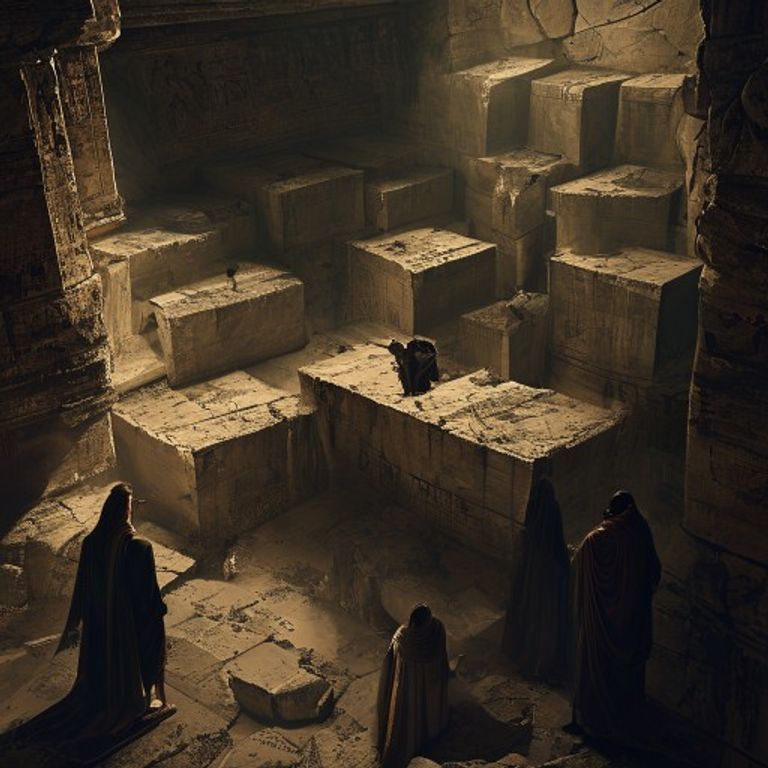
Deep beneath the sands of Saqqara, a vast necropolis west of ancient Memphis, lies one of Egypt’s most perplexing archaeological sites: the Serapeum. Discovered in 1850 by the French Egyptologist Auguste Mariette, this subterranean complex is a network of galleries and chambers hewn directly into the bedrock. Mariette’s excavation, driven by accounts from classical writers like Strabo, uncovered an extraordinary sight: colossal sarcophagi of polished granite, weighing tens of tons, each resting within its own recessed chamber. The sheer scale of the undertaking, from the precise carving of the rock-cut passages to the meticulous finishing of the massive stone boxes, immediately presented a profound challenge to existing understandings of ancient Egyptian capabilities. The atmosphere within these chambers is one of profound silence and immense weight, a testament to an ambition that transcended the ordinary.
The Serapeum’s primary identity, according to mainstream Egyptology, is as a burial place for the sacred Apis bulls. These bulls, believed to be incarnations of the god Ptah, were revered during their lifetime and, upon their death, were mummified and interred with elaborate ceremonies. Mariette’s discovery of a largely intact burial chamber with a mummified bull, though not in one of the grand granite boxes, cemented this interpretation. Yet, the grandeur and engineering precision of the larger, empty sarcophagi have always stirred a deeper curiosity, prompting some to question if their function was solely for animal interment. The long history of the site, spanning from the reign of Amenhotep III in the New Kingdom through the Late Period and into Ptolemaic times, suggests a continuous tradition, but the quality of the earliest and largest boxes remains unparalleled.
Walking through the cool, dark corridors, one cannot help but feel dwarfed by the sheer volume of rock removed and the monumental structures left behind. The main gallery alone stretches for hundreds of meters, with niches carved into its sides, each housing one of these enormous stone containers. The mystery deepens when considering the logistics of their placement. How were these immense blocks of stone, some estimated to weigh upwards of 80 to 100 tons, maneuvered through narrow passages and lowered into their resting places, often with barely inches to spare? This initial encounter with the Serapeum immediately frames it not just as an archaeological site, but as a profound engineering puzzle awaiting a comprehensive solution.
Unveiling the Enigmatic Granite Boxes
The true marvel of the Serapeum lies in its granite and diorite sarcophagi. Fashioned from some of the hardest stones known to ancient Egyptians, these monolithic containers represent an apex of stonework. Their dimensions are staggering: typically around 4 meters (13 feet) long, 2.5 meters (8 feet) wide, and 3.3 meters (11 feet) high, with solid lids weighing almost as much as the boxes themselves. The internal volume is often precisely carved, with surfaces polished to a mirror-like sheen. What truly sets them apart is the level of precision in their construction. Measurements reveal astonishingly flat surfaces and perfectly square internal corners, often within tolerances that challenge modern machining capabilities, let alone those attributed to Bronze Age tools.
The material choice itself presents a significant hurdle for conventional theories. Granite and diorite are exceptionally difficult to work, requiring immense force and advanced abrasive techniques. Traditional Egyptian toolkits, primarily composed of copper chisels, bronze saws, and dolerite pounders, struggle to account for the consistent precision seen in the Serapeum boxes. Copper, a relatively soft metal, is ineffective against granite, suggesting the use of hardened abrasives like quartz sand in conjunction with sawing, but even then, maintaining such exactitude over large surfaces is a monumental task. The question extends beyond cutting to the intricate polishing processes, which must have consumed vast amounts of time and labor, yielding surfaces that still reflect light thousands of years later.
Furthermore, the lids of these sarcophagi fit with an uncanny exactness, suggesting a masterful understanding of fitting and sealing. Some lids bear evidence of sliding mechanisms, while others appear to have been lowered into place with incredible precision, creating a near-airtight seal. This degree of engineering would have required not only skilled artisans but also a sophisticated understanding of measurement, geometry, and mechanical advantage. The sheer volume of material removed, the consistent quality of the finish, and the precise geometric forms found within the subterranean complex underscore a level of technological proficiency that continues to fuel debate among Egyptologists and independent researchers alike. The boxes stand as silent witnesses to an expertise that remains difficult to fully reconcile with the accepted narrative of ancient Egyptian tool capabilities.
Archaeological Interpretations: Bulls or Something More?
The prevailing archaeological consensus, initially championed by Auguste Mariette, posits that the Serapeum’s monumental boxes were sarcophagi for the sacred Apis bulls. Evidence for this interpretation includes numerous stelae found within the complex, which commemorate deceased Apis bulls and provide valuable chronological data. Additionally, Mariette did find some evidence of bull burials, though typically these were not within the massive granite boxes themselves but in smaller, less grand chambers or pits within the larger necropolis. The presence of these stelae and the general religious context of Saqqara as a necropolis for animal cults certainly supports the idea of the site’s reverence for the Apis bull.
However, the sheer scale and the meticulous, almost excessive, precision of the colossal granite boxes have led some scholars and independent researchers to question whether their purpose was exclusively, or even primarily, for animal internment. Critics of the mainstream view point to several inconsistencies. Firstly, of the approximately twenty-four large sarcophagi within the main galleries, only one or two have shown any definitive evidence of containing an Apis bull burial, and even those instances are subject to some debate about whether the bull remains were primary or secondary interments. Many of the boxes were found empty, or disturbed by ancient plunderers, making conclusive identification challenging. This lack of consistent evidence within the grandest boxes themselves raises questions about their universal function as bull sarcophagi.
Secondly, the engineering involved seems disproportionate to the task of burying a bull, even a sacred one. While venerated, an Apis bull’s remains, though significant, do not inherently require a 100-ton, perfectly carved granite container for preservation. Smaller, less elaborate, and archaeologically more common sarcophagi were perfectly adequate for human pharaohs and high-ranking officials. Some argue that such extraordinary effort and precision imply a different, perhaps more complex, function. The enduring mystery surrounding many Egyptian sites, and the questions they pose about the extent of ancient capabilities, often invite us to consider alternative interpretations, especially when primary evidence within the most striking artifacts themselves remains elusive. Questions about the ultimate purpose of the Serapeum’s largest boxes continue to echo through the subterranean chambers, leaving researchers to ponder if there’s more to their story, much like the broader unsolved mysteries of other ancient Egyptian sites.
Engineering Puzzles: A Question of Ancient Techniques
The construction of the Serapeum’s granite boxes presents a formidable challenge to our understanding of ancient Egyptian technology. To achieve the level of precision observed – surfaces flat to within fractions of a millimeter, internal corners perfectly square, and dimensions consistent over several meters – with the tools commonly ascribed to the period, seems a Herculean task. Mainstream Egyptology suggests the use of copper and bronze chisels for softer stones, and for harder materials like granite, the application of pounding stones made of dolerite, combined with abrasive quartz sand, and possibly tubular drills for circular cuts. This methodology relies heavily on laborious manual effort and prolonged abrasion.
However, applying these known techniques to the Serapeum boxes raises immediate concerns. Copper chisels would dull instantly against granite, rendering them largely useless for shaping. Dolerite pounding, while capable of crushing rock, typically leaves a rough, pitted surface, not the smooth, polished finishes seen. For precision cuts and perfectly flat surfaces, a straight edge and consistent pressure across a large area are essential, something difficult to achieve with hand-held pounding stones. Even with abrasive sands, maintaining such perfect flatness over large areas requires guide rails and tools that can move with extremely consistent force and direction, for which there is little direct archaeological evidence in the Egyptian toolkit.
Consider the internal corners of the boxes, which are often observed to be perfectly sharp and square, a feat incredibly difficult to achieve even with modern machinery without specialized tooling. To replicate this manually with abrasive slurry would require an unimaginable amount of time and an accuracy of eye and hand that borders on the superhuman. Some researchers, like Christopher Dunn, an engineer who has studied the precision of ancient Egyptian artifacts extensively, argue that these features are indicative of machining processes that go far beyond simple hand tools and abrasives. He posits that the evidence points to a technology capable of rotating tools at high speeds and applying constant, guided pressure, suggesting a more advanced level of engineering than commonly accepted for the dynastic periods. This debate highlights the gap between what we know of ancient tools and the physical evidence left in the Serapeum.
A Legacy of Precision: From Quarries to Chambers
The journey of the Serapeum’s monumental boxes, from their source in the distant quarries to their final resting places in the subterranean chambers of Saqqara, represents an astonishing logistical and engineering triumph. Most of the hard stone used, particularly granite, was quarried hundreds of kilometers to the south, near Aswan. Transporting these massive blocks, some weighing over 80 tons, would have involved sophisticated methods of riverine transport via barges on the Nile, followed by arduous overland hauls across the desert to Saqqara. This alone would have necessitated vast organized labor, intricate rope and pulley systems, and perhaps even purpose-built sledges and ramps, for which some evidence exists in other contexts.
Yet, the challenge extends beyond mere transport. Upon arrival at the Serapeum, these raw blocks, though likely pre-cut to some extent at the quarry, still required final shaping, finishing, and precise placement within the already excavated rock-cut chambers. The accuracy with which the boxes fit into their niches, often with only minimal clearance, implies meticulous pre-planning and exactitude in both excavation and stone dressing. One can imagine the painstaking process of maneuvering such immense weight through relatively confined spaces, inch by agonizing inch, using leverage, rollers, and human power. This speaks to an advanced understanding of mechanics and material handling that is often overlooked in popular narratives.
Furthermore, the internal surfaces of these boxes, exhibiting remarkable flatness and precise geometry, stand in stark contrast to much of the more roughly finished stonework found elsewhere in Egypt. This selective application of extreme precision — lavished on containers hidden underground, unseen by any public — is itself part of the puzzle. If the boxes were merely sarcophagi for animals, why invest such extraordinary effort in surfaces no worshipper would ever admire? The quarrying, transport, and final placement each demanded a different mastery, and together they describe a chain of expertise that leaves little room for improvisation. Every stage had to succeed, because a single crack in a 70-tonne granite box would have rendered years of labour worthless.
Weighing the Evidence: What the Serapeum Can and Cannot Tell Us
It is tempting, standing before these boxes, to reach for extraordinary explanations. The precision is real, the scale is genuine, and mainstream Egyptology has not always been eager to dwell on the mechanical questions they raise. But the honest position is more restrained than either the textbook or the fringe would prefer. We do not have a complete account of how the boxes were made, and admitting that gap is not the same as filling it with lost technology.
What the archaeological record does support is a picture of New Kingdom and Late Period Egypt as a society capable of astonishing feats of organised labour and accumulated craft knowledge. The dolerite pounders, copper saws, and quartz-sand abrasives found across Egyptian sites are crude individually, but applied by thousands of trained hands over months, they can accomplish what seems impossible to a modern eye accustomed to machines. The absence of surviving tools sophisticated enough to explain the finish is a genuine problem — but absence of a tool in the record is not proof it never existed.
Where writers like Christopher Dunn see evidence of a lost machine age, most Egyptologists see a knowledge base that was oral, guild-held, and ultimately lost when the culture that sustained it faded. Both readings acknowledge the same uncomfortable fact: the how remains partly unanswered. The difference lies in what one is willing to infer from silence.
Perhaps the most intellectually honest conclusion is that the Serapeum marks the outer edge of what we can currently reconstruct about ancient Egyptian capability. It is neither proof of a vanished super-civilisation nor a fully solved case. It is a standing challenge — a set of stone boxes that continue to ask harder questions of us than we can yet answer, and that reward careful investigation far more than easy certainty in either direction.
Researching declassified archives and deciphering ancient secrets requires a lot of time and resources. If you like these stories from the cradle of civilization, support the digital scribe in his further work and buy him a coffee.
Enjoyed this topic? Explore these recommended books for further reading.
Agartha: The Earth's Inner World
Ancient Egipt: Magicians of the Gods
Atlantis: Atlantis and the Ten Plagues of Egypt: The Secret History Hidden in the Valley of the Kings
Lemuria: The Lost Civilization of Lemuria: The Rise and Fall of the World's Oldest Culture
Sumer: The Sumerians: A History From Beginning to End (Mesopotamia History)
Tartaria: The One World Tartarians (Black and White): The Greatest Civilization Ever Erased From History
As an Amazon Associate I earn from qualifying purchases at no extra cost to you. Thank you for your support!