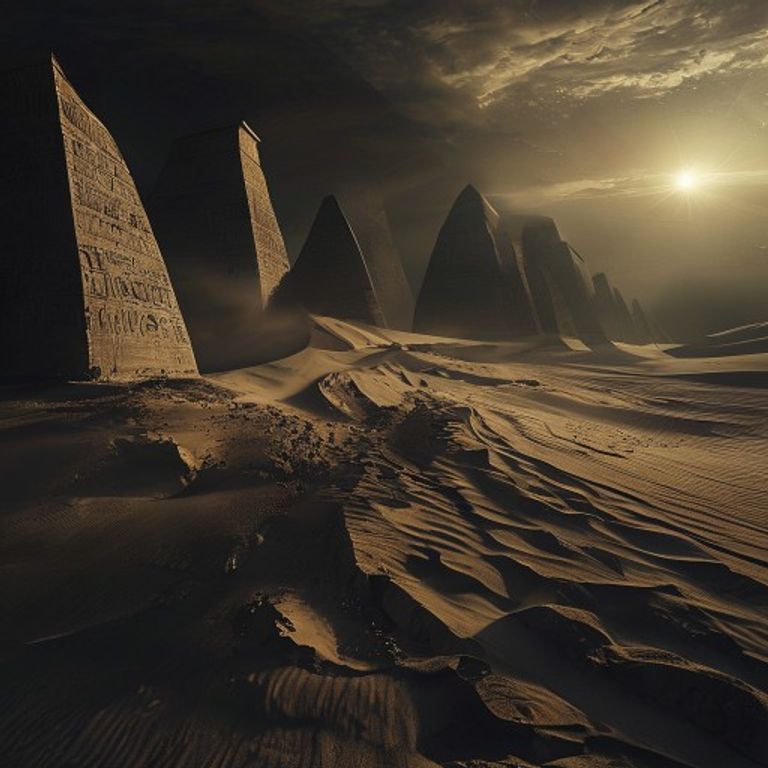
The Silent Sands: Declassified Secrets of Ancient Egypt’s Unsolved Mysteries
Imagine a civilization that rose from the desert sands, not gradually, but with a sudden, breathtaking brilliance. A civilization that mastered engineering, astronomy, and medicine thousands of years before its time, leaving behind monuments that defy our modern understanding. Ancient Egypt. We think we know it – pyramids, pharaohs, mummies, and an endless river of historical facts. But what if the official story, the one etched into our textbooks, is just a meticulously constructed facade, a cover for something far more profound, far more… enigmatic?
For centuries, archaeologists have sifted through the dust and debris of this ancient empire, piecing together a narrative of gods, kings, and common folk. Yet, beneath the veneer of historical consensus, questions simmer. How did they achieve such architectural precision without modern tools? Where did their advanced astronomical knowledge truly come from? And why, despite centuries of excavation, do vast swathes of their history remain stubbornly silent, shrouded in the desert’s timeless embrace? This isn’t just history; it’s a cold case, an archaeological enigma begging for a fresh pair of eyes, and perhaps, some newly unearthed ‘documents’ from unexpected sources.
The Case File: A Civilization Beyond Its Time
For over three thousand years, the Nile Valley cradled a power unlike any other. From the unification under Narmer around 3100 BCE to the twilight of Cleopatra, Ancient Egypt endured, a testament to human ingenuity and spiritual devotion. Its achievements are legendary: the Great Pyramid of Giza, a geometric marvel aligned with celestial precision, containing millions of precisely cut stones, some weighing many tons, lifted to impossible heights; the enigmatic Sphinx, carved from a single colossal bedrock, staring into eternity with eyes that seem to hold untold secrets; the intricate hieroglyphs, a language of gods and kings, preserving knowledge of medicine, mathematics, and a complex cosmology.
But the sheer scale and sophistication of these accomplishments continue to baffle. How did a civilization, supposedly operating with only copper tools and rudimentary understanding of physics, construct structures that challenge even our modern engineering capabilities? The precise alignments of the pyramids with cardinal directions and specific stars, the uncanny accuracy of their stonework, the seemingly impossible feat of transporting massive blocks across vast distances – these are not mere curiosities. They are anomalies, glaring inconsistencies in the accepted historical narrative. Are we truly to believe that sheer manpower and simple ramps were enough to achieve such perfection? Or is there something more, something hidden beneath the layers of sand and scholarly interpretation?
Many mainstream historians dismiss these questions as the musings of fringe theorists. But what if the answers lie not in ancient papyri or tomb paintings, but in the archives of institutions we least expect? What if the very agencies tasked with safeguarding national security and exploring the cosmos have, in their own quiet way, stumbled upon fragments of truth that challenge everything we thought we knew about Ancient Egypt?
The Evidence: Declassified Glimpses into the Unknown
Our investigation takes an unconventional turn now, delving into the shadows of modern intelligence and scientific exploration. The following ‘evidence’ isn’t about direct proclamations of alien intervention or lost super-technology, but rather subtle hints, curious observations, and strategic interests that, when viewed through the lens of an investigative journalist, paint a provocative picture of a hidden truth.
NASA’s Satellite Secrets: Anomalies Beneath the Sands
Imagine, if you will, the hushed corridors of NASA in the late 1970s. While the world looked to the stars, a small, dedicated team was quietly turning their gaze downwards, towards the very sands of Earth. Declassified NASA technical report, reference number NSS-78-003-A, dated 1978, titled “Anomalous Subsurface Signature Analysis – North African Quadrant.” On its surface, a mundane geological survey. But delve deeper, past the scientific jargon of ‘gravimetric fluctuations’ and ‘unexplained density variations,’ and a different picture emerges.
This document details unusual energy readings and structural anomalies detected by early satellite imaging beneath the Giza plateau. Not just random geological quirks, mind you, but ‘non-natural geometric patterns’ stretching for miles, far beneath the visible monuments. The report cautiously notes ‘indications of extensive, structured subterranean complexes’ that do not align with known archaeological sites. What were these patterns? Why were they so precisely structured? And why was NASA, an agency dedicated to space exploration, so keenly interested in what lay hidden beneath the desert floor? Was it merely an academic curiosity, or was there a deeper, more profound reason for their clandestine mapping of what could only be described as a vast, subterranean network, predating anything we thought possible? This document, stripped of its scientific euphemisms, suggests that our understanding of Giza’s true scale might be literally superficial.
CIA’s Strategic Interest: Ancient Knowledge as a Modern Threat?
Then there’s the CIA. An agency synonymous with secrets, with geopolitical chess games played in the shadows. A document, partially redacted, from 1963, labeled “Special Assessment: Cultural Heritage & Strategic Influence – MENA Region.” While ostensibly about protecting cultural sites from theft or destruction, the subtext is chilling. It discusses the ‘potential for destabilization arising from significant archaeological discoveries’ in Egypt and the broader Middle East. The report mentions ‘unverified reports of unconventional energy sources’ and ‘ancient technological artifacts’ being sought by various foreign entities, implying a Cold War scramble not just for oil, but for something far more esoteric.
Why would the CIA be concerned with ancient technology? Was it merely a Cold War scramble for resources, or did they suspect that some ancient Egyptian knowledge held practical, perhaps even strategic, applications that could shift the global balance of power? The document’s emphasis on ‘controlling the narrative’ around certain discoveries hints at a deeper game – one where information about ancient capabilities could be deemed a national security asset, or a threat. This isn’t about protecting statues; it’s about controlling information, controlling power, and perhaps, preventing a paradigm shift that could upend global order.
FBI’s Interception: Non-Terrestrial Data and Esoteric Societies
And what about the FBI? Their jurisdiction rarely extends beyond U.S. borders, yet a fascinating memorandum, ‘Operation Sphinx Shield’, dated 1992, details an international collaborative effort to combat the illicit trade of Egyptian antiquities. But buried within the operational reports are references to ‘artifacts of unknown composition’ and ‘texts containing non-terrestrial astronomical data’ seized from a private collector with alleged ties to an esoteric society. The memorandum describes the items as ‘possessing properties inconsistent with known ancient manufacturing techniques’ and the texts as presenting ‘celestial mechanics beyond the scope of established ancient Egyptian astronomy.’
Why the specific interest in ‘non-terrestrial’ data? Was the FBI merely recovering stolen goods, or were they, perhaps unknowingly, intercepting fragments of a lost history, pieces of a puzzle that could rewrite our understanding of humanity’s origins and its connection to the cosmos? The mention of esoteric societies suggests that certain groups have long been aware of these hidden truths, actively seeking out artifacts that could unlock profound secrets. This document, more than any other, hints at a deliberate suppression or at least a careful management of information that could challenge our most fundamental beliefs about the past.
Why It Matters Today: Reclaiming Our Lost History
These fragments of declassified information, scattered across different agencies and decades, paint a provocative picture. They suggest that the U.S. intelligence community and its scientific counterparts, far from dismissing ancient mysteries as mere folklore, have quietly been observing, documenting, and perhaps even investigating aspects of Ancient Egypt that challenge our conventional understanding. If these powerful institutions, with their vast resources, have found reason to look beyond the textbooks, shouldn’t we?
The implications are staggering: a re-evaluation of human capabilities, a reconsideration of our place in the universe, and a profound challenge to the linear narrative of progress we so readily accept. What if the ‘ancients’ weren’t primitive, but possessed a different, perhaps superior, form of knowledge – a knowledge that was either lost to catastrophe, deliberately concealed, or simply beyond our current comprehension? What if the secrets of Ancient Egypt hold keys not just to our past, but to our future? To dismiss these possibilities is to ignore the very evidence that modern agencies, in their own cryptic ways, have deemed worthy of their attention.
This isn’t about conspiracy theories; it’s about connecting the dots, interpreting the silences, and daring to ask uncomfortable questions. It’s about recognizing that the official narrative might be incomplete, and that a richer, more complex truth lies beneath the surface, waiting to be unearthed not just by the archaeologist’s trowel, but by the inquisitive mind.
Conclusion: The Enduring Whisper of the Past
The sands of Egypt guard their secrets fiercely. The monumental structures stand as silent sentinels, enduring witnesses to a past we are only beginning to comprehend. But as we sift through the grains of history, armed with new perspectives and a willingness to question, the whispers of a forgotten past grow louder. The declassified files, however fragmented and open to interpretation, serve as tantalizing breadcrumbs, leading us down a rabbit hole of possibility.
Ancient Egypt isn’t just a chapter in a history book; it’s an ongoing investigation, a profound mystery waiting to be unraveled. It challenges us to reconsider the very foundations of our knowledge, to look beyond the obvious, and to embrace the notion that history is not a static record, but a living, breathing enigma. And perhaps, the greatest secret it holds isn’t buried beneath the desert, but within our own minds – the capacity to imagine, to question, and to finally see beyond the veil of what we think we know. What other truths lie hidden, waiting for us to connect the dots?
Researching declassified archives and deciphering ancient secrets requires a lot of time and resources. If you like these stories from the cradle of civilization, support the digital scribe in his further work and buy him a coffee.
Enjoyed this topic? Explore these recommended books for further reading.
Agartha: The Earth's Inner World
Ancient Egipt: Magicians of the Gods
Atlantis: Atlantis and the Ten Plagues of Egypt: The Secret History Hidden in the Valley of the Kings
Lemuria: The Lost Civilization of Lemuria: The Rise and Fall of the World's Oldest Culture
Sumer: The Sumerians: A History From Beginning to End (Mesopotamia History)
Tartaria: The One World Tartarians (Black and White): The Greatest Civilization Ever Erased From History
As an Amazon Associate I earn from qualifying purchases at no extra cost to you. Thank you for your support!