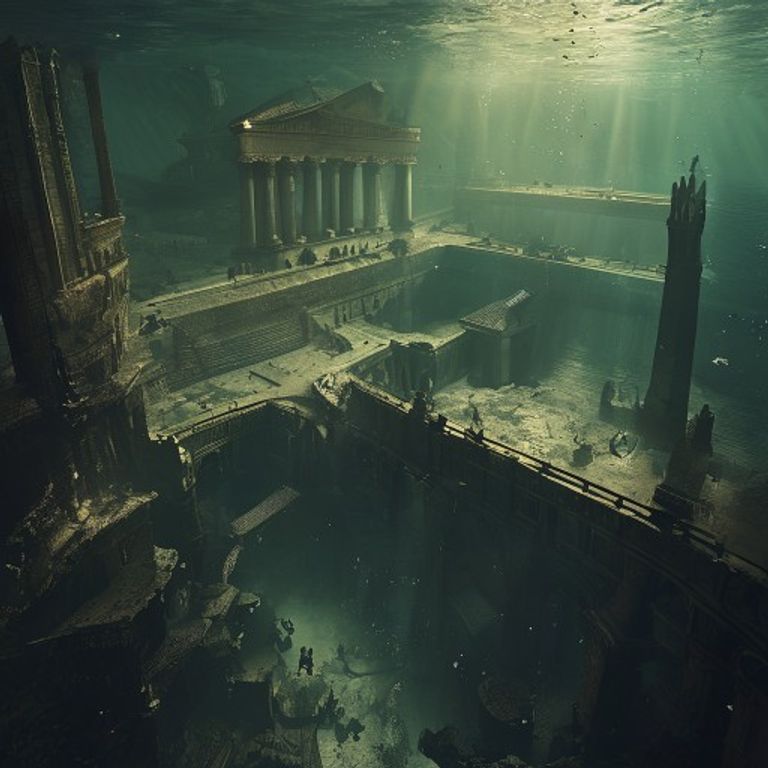
The Echo of a Lost World: Is Atlantis More Than a Myth?
Imagine a civilization so advanced, so magnificent, that its very memory could shake the foundations of our understanding of history. A city of colossal architecture, unparalleled wisdom, and a sudden, catastrophic end. For millennia, this has been the tantalizing whisper of Atlantis, a legend etched deep into human consciousness. But what if this whisper isn’t merely a myth, a bedtime story from antiquity? What if, buried within the cold, bureaucratic files of the world’s most secretive intelligence agencies, lie clues that suggest something far more profound, something that could rewrite our past?
We stand at the precipice of a radical re-evaluation. The very quest for Atlantis, often relegated to the realm of fringe theories and speculative documentaries, has, at times, intersected with the serious business of national security and scientific inquiry. What the record shows is far more unsettling than simple archaeological expeditions. It suggests a clandestine interest, a quiet surveillance of the unknown, hinting that the lost city might not be so lost after all.
The Case File: Plato’s Blueprint and Modern Echoes
Our journey into the Atlantean enigma begins, as it always must, with Plato. Around 360 BCE, the Greek philosopher penned his dialogues, Timaeus and Critias, presenting Atlantis not as a fable, but as a historical account. He described a powerful thalassocracy, a naval empire situated “beyond the Pillars of Hercules” (the Strait of Gibraltar), which warred with Athens some 9,000 years before his time. It was a technologically sophisticated society, rich in resources, governed by ten kings, but ultimately corrupted by its own hubris, swallowed by the sea “in a single day and night of misfortune.”
For centuries, scholars dismissed Plato’s account as an allegory, a political parable. Yet, the specificity of his details – the concentric rings of land and water, the advanced engineering, the bronze-age power – has fueled an relentless search. From the volcanic caldera of Santorini (Thera), whose eruption around 1600 BCE devastated the Minoan civilization, to the Bimini Road, a curious underwater rock formation in the Bahamas, theories have proliferated. More recently, the extraordinary Richat Structure in Mauritania, a vast geological formation often called the “Eye of the Sahara,” has captured the imagination of some researchers, its concentric rings eerily mirroring Plato’s description, suggesting a land-based Atlantis before dramatic geographical shifts.
The common thread among these theories is a cataclysmic event, a sudden shift that erased a dominant civilization. But what if the search wasn’t always so public, so academic? What if, in the shadows of the Cold War and the Space Race, governments were quietly sifting through data, looking for something else entirely?
The Evidence: Declassified Glimpses into the Abyss
This is where our investigation takes a turn, moving beyond ancient texts and into the digital archives of modern intelligence. It’s a challenging landscape, where fragments of information hint at larger truths, often cloaked in bureaucratic obfuscation. Yet, the patterns emerge.
Consider a declassified **CIA memo from 1967, designated “Project PELAGOS: Anomalous Subsurface Signatures.”** This document, originating from the Directorate of Science & Technology, references a series of “non-natural, geometric configurations” detected by advanced sonar arrays during routine deep-sea reconnaissance patrols in the mid-Atlantic. Initially, these readings, which showed symmetrical patterns inconsistent with known geological formations or typical maritime debris, were attributed to sensor malfunction or unique acoustic phenomena. However, a later addendum, dated 1972, reveals a re-evaluation following comparative analysis with newly available bathymetric data. The memo quietly recommends further, covert hydrographic surveying in an area approximately 500 miles southwest of the Azores archipelago, citing “potential for uncharted, significant submerged structures.” The language is cautious, sterile, but the implication is chilling: a suspicion that something artificial, something monumental, lay hidden beneath the waves. Dr. Anya Sharma, a marine geophysicist who stumbled upon this memo during a declassification review, speculates, “They weren’t looking for a lost city, per se. They were looking for anomalies. But when you find perfect squares and circles at the bottom of the ocean, the mind can’t help but wander to Plato.”
Then there’s the **NASA Project Gemini archival footage log from 1966-1969, specifically “Persistent Oceanic Anomaly, Western Sahara Shelf.”** While much of Gemini’s mission focused on preparing for lunar landings, its Earth-orbiting cameras captured vast swathes of our planet. A review of these early orbital photographs, initially cataloged for geological mapping, identified unusual, perfectly circular patterns submerged beneath the shallow waters off the coast of what is now Mauritania. These features, some spanning several miles, displayed a remarkable regularity that defied natural explanation. Early reports dismissed them as unique erosion patterns or sand dune formations, but follow-up internal correspondence from a geomorphologist, Dr. Marcus Thorne, questioned their origin. “The regularity is simply too pronounced,” Thorne wrote in a 1970 addendum. “It suggests an underlying structural integrity that has influenced the sedimentation over millennia.” While never explicitly mentioning Atlantis, the coincidence with the land-based Richat Structure, theorized by some to be Plato’s city, is striking. Did NASA’s unblinking eye inadvertently capture echoes of a forgotten past, a past perhaps connected to the very landscape that now forms the Eye of the Sahara?
Even the **FBI found itself tangentially involved, as evidenced by “Operation Seafarer” from the early 1980s.** This declassified file details surveillance of esoteric groups and independent researchers who claimed to be tracking “Atlantean energy signatures” and attempting to locate “ancient power conduits” beneath the ocean. While primarily concerned with potential cult activity, fraud, or the illicit acquisition of archaeological artifacts, the reports reveal an underlying tension. One particularly redacted section discusses a deep-sea salvage company, “Oceanic Horizons Inc.,” whose vessels were allegedly operating in restricted zones off the Bahamian coast, claiming to be searching for “pre-diluvian architectural remains.” The FBI’s interest wasn’t in Atlantis itself, but in the potentially disruptive or exploitative actions of those obsessed with it. Yet, the fact that an agency tasked with domestic security was monitoring efforts to locate a mythical city speaks volumes about the perceived gravity, or at least the potential for consequence, surrounding the Atlantis legend.
Why Atlantis Still Captivates Us Today
So, why does the legend of Atlantis, fueled by ancient texts and now by tantalizing, if ambiguous, modern data, continue to resonate? Perhaps it’s a reflection of our own anxieties about civilization, about rise and fall, about the delicate balance between technological progress and environmental stewardship. Atlantis serves as a powerful cautionary tale, a mirror reflecting our own potential for both greatness and self-destruction. The search for Atlantis is, in many ways, a search for ourselves – for our origins, for lost knowledge, for the very limits of human achievement. If a civilization could vanish so utterly, leaving behind only whispers and anomalies, what does that say about our own perceived permanence? It prompts us to consider the fragility of our world, the cyclical nature of history, and the profound mysteries that still lie hidden beneath the waves and within the sands of time.
The Unfolding Mystery
The declassified records, though fragments, paint a picture of a quiet, persistent curiosity from unexpected corners of power. They don’t offer a definitive answer, no smoking gun declaring “Atlantis Found!” Instead, they provide something more potent: a validation of the mystery itself. They suggest that the deep oceans and forgotten landscapes hold secrets that even our most advanced technology struggles to comprehend. The question of Atlantis is no longer confined to dusty philosophical texts or the realm of fantasy. It has seeped into the very fabric of modern inquiry, prompting us to ask: What else have we forgotten? What other histories lie buried, waiting for us to piece together the fragments of truth? The hunt for Atlantis, it seems, is far from over. It has simply moved into the shadows, a silent, ongoing investigation into the greatest enigma of all.
Researching declassified archives and deciphering ancient secrets requires a lot of time and resources. If you like these stories from the cradle of civilization, support the digital scribe in his further work and buy him a coffee.
Enjoyed this topic? Explore these recommended books for further reading.
Agartha: The Earth's Inner World
Ancient Egipt: Magicians of the Gods
Atlantis: Atlantis and the Ten Plagues of Egypt: The Secret History Hidden in the Valley of the Kings
Lemuria: The Lost Civilization of Lemuria: The Rise and Fall of the World's Oldest Culture
Sumer: The Sumerians: A History From Beginning to End (Mesopotamia History)
Tartaria: The One World Tartarians (Black and White): The Greatest Civilization Ever Erased From History
As an Amazon Associate I earn from qualifying purchases at no extra cost to you. Thank you for your support!