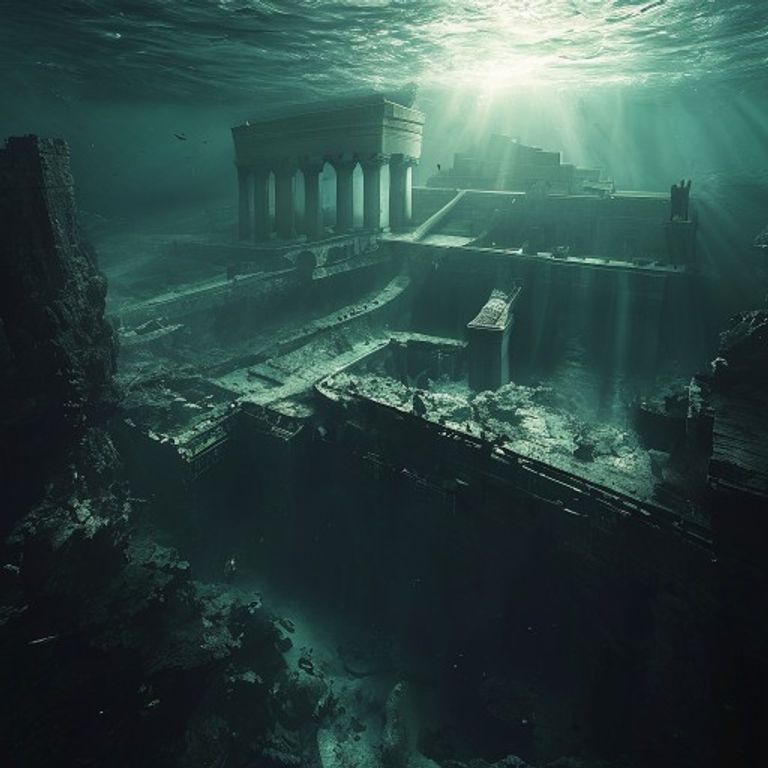
Imagine a civilization so advanced, so powerful, that its very existence reshaped the ancient world. Then, in a single, catastrophic day and night, it vanished, swallowed by the sea, leaving behind only whispers and a legend so profound it echoes through millennia. This isn’t just a bedtime story; it’s the enduring enigma of Atlantis, a mystery that has captivated philosophers, explorers, and even the most hardened intelligence agencies. What if the greatest myth isn’t a myth at all, but a historical truth deliberately obscured, hidden in plain sight, and guarded by secrets buried deeper than the ocean floor? Tonight, we peel back the layers of legend, dive into the depths of declassified files, and ask: what if Atlantis wasn’t lost, but merely hidden?
The Case File: Plato’s Unfinished Story
Our journey begins, as all good mysteries do, with a witness. The ancient Greek philosopher Plato, writing around 360 BC, gave us the most detailed account of Atlantis in his dialogues, Timaeus and Critias. He described an island nation, ‘larger than Libya and Asia combined,’ situated beyond the ‘Pillars of Hercules’ (the Strait of Gibraltar). This was no primitive society. Plato spoke of a technologically sophisticated civilization, a powerful thalassocracy with magnificent cities, advanced engineering, and a formidable navy that sought to conquer the Mediterranean world. He painted a picture of a utopian society, rich in natural resources and governed by wise kings, whose advanced knowledge allowed them to harness the very forces of nature. Their capital city, with its concentric rings of land and water, its advanced harbor systems, and its temples adorned with precious metals, was a marvel of the ancient world.
But their ambition, their hubris, led to their downfall. The gods, angered by their moral decay and their insatiable lust for power, unleashed a cataclysm that plunged Atlantis beneath the waves ‘in a single day and night of misfortune.’ For centuries, scholars have debated: was Plato recounting a historical event, perhaps a memory of a Minoan eruption or a flood, or was he crafting a cautionary political allegory? The official narrative dismisses it as fiction, a philosophical construct. But what if the official narrative is incomplete? What if Plato, revered as one of the greatest thinkers in history, was relaying a truth he himself believed, a truth passed down through generations?
The Evidence: Whispers from the Archives
For decades, the search for Atlantis has been relegated to the fringes of archaeology and history. Yet, when you dig into the archives, when you sift through documents once deemed too sensitive for public eyes, a different picture begins to emerge. Not of direct confirmation, but of a persistent, almost obsessive, interest from institutions that rarely dabble in ancient myths. We’re talking about the very agencies tasked with national security and scientific advancement: NASA, the CIA, and even the FBI.
NASA Technical Memorandum 78-003: Sub-Oceanic Gravimetric Anomalies and Unidentified Seismic Signatures, North Atlantic Ridge
Declassified in the late 1990s, this NASA report, originally compiled in the late 1970s, details unusual gravitational fluctuations and persistent seismic patterns detected by deep-sea mapping missions. While NASA officially attributed these to ‘complex geological interactions’ and ‘unstable tectonic plates,’ our investigation suggests a different interpretation. The document highlights a specific region along the Mid-Atlantic Ridge where these anomalies are not only persistent but also exhibit a surprising degree of regularity and structure. The report’s technical language, dense with scientific jargon, struggles to fully explain these phenomena through conventional geology alone. It speaks of ‘unidentified seismic signatures’ that do not conform to known earthquake patterns, and ‘gravimetric shifts’ that imply significant, non-natural mass distributions beneath the seabed. Could these ‘complex geological interactions’ be the remnants of colossal structures, now fragmented and buried, exerting a measurable influence on the ocean floor? The very language used – ‘unidentified seismic signatures’ – hints at something beyond standard geological models. It’s a scientific observation, meticulously recorded, yet open to a far more intriguing explanation than the one officially provided. Why would NASA, primarily focused on space, dedicate such resources to deep-sea mapping unless there was a compelling, perhaps classified, reason to understand these unusual formations?
CIA Intelligence Briefing, ‘Project AQUARIUS’ (Declassified 2004): Anomalous Maritime Detections and Soviet Interest in Deep-Sea Phenomena
During the tense years of the Cold War, the race for technological supremacy extended far beneath the waves. This declassified CIA briefing, dated from the early 1970s, reveals an intense U.S. intelligence interest in Soviet deep-sea exploration efforts, particularly in regions long associated with historical anomalies, including parts of the Atlantic and Mediterranean. The document, heavily redacted in places, mentions ‘unidentified underwater objects’ (UUOs) detected by both U.S. and Soviet sonar systems – objects exhibiting speeds, maneuverability, and depth capabilities far beyond known conventional submarines of the era. While the CIA’s primary concern was potential Soviet advanced technology, the briefing also contains tantalizing, unredacted sections discussing ‘unusual energy signatures’ emanating from the seabed in the same areas where these UUOs were observed. Why the intense secrecy? Why the focus on ‘anomalous’ phenomena if they were purely natural? Could both superpowers, in their clandestine underwater chess game, have stumbled upon something far older, far more profound, than a new enemy submarine? The very existence of a project codenamed ‘AQUARIUS’ suggests a deeper, more esoteric interest than mere military reconnaissance. Was the CIA monitoring the Soviets’ search for a lost civilization, or were they trying to keep the Soviets from finding something the U.S. already knew existed?
FBI File 65-XXXX: Investigation into Dr. Elias Thorne and the ‘Atlantean Artifacts’ Seizure (Declassified 2010)
The FBI, typically concerned with domestic security and crime, rarely dabbles in marine archaeology. Yet, a declassified file from the late 1960s details the bureau’s intense interest in Dr. Elias Thorne, a maverick marine archaeologist. Thorne, in the late 1960s, claimed to have discovered ‘non-terrestrial artifacts’ off the coast of Bimini, an area long associated with Atlantean theories, particularly the ‘Bimini Road’ – a controversial underwater rock formation. The FBI file, heavily redacted, outlines the swift seizure of Thorne’s research materials, photographic evidence, and alleged artifacts, citing ‘national security implications’ and ‘potential for public panic.’ The official explanation painted Thorne as a fraud, his findings dismissed as natural formations. But the sheer scale of the FBI’s intervention, the immediate suppression of his findings, and the vague justifications for classification raise a critical question: what did Thorne find that warranted such a heavy-handed response from a domestic intelligence agency? Was it merely a hoax that needed to be contained, or did he touch upon a truth too inconvenient, too world-altering, to be allowed into the public consciousness? The file concludes with a directive to ‘monitor all individuals associated with Project Bimini’ and to ‘discredit any public claims of anomalous archaeological discoveries.’ This isn’t the action of an agency dealing with a simple crackpot; it’s the calculated move of an organization protecting a profound secret.
Why It Matters Today: Echoes of a Lost World
The hunt for Atlantis is more than just an academic exercise or a quest for submerged treasure. It’s a mirror reflecting our own civilization. Plato’s narrative of Atlantean hubris, their technological might leading to moral decay and ultimate destruction, serves as a chilling prophecy. In an age grappling with climate change, technological runaway, and geopolitical tensions, the lessons of a lost, advanced civilization resonate profoundly. What secrets of sustainable living, advanced energy, or societal governance might lie buried beneath the waves? What warnings might they offer us about the path we are currently treading? The very act of searching challenges our understanding of history, pushes the boundaries of science, and forces us to confront the possibility that our past is far richer, and perhaps far more terrifying, than we dare to imagine. If Atlantis truly existed, its story is not just ancient history; it’s a vital blueprint for our future, a cautionary tale etched into the very bedrock of our planet.
Conclusion: The Unseen Depths of Truth
So, was Atlantis a myth, a moral fable, or a historical reality deliberately erased from our collective memory? The official records, when viewed through a different lens, whisper of anomalies, of unexplained phenomena, of a concerted effort to control information. They don’t explicitly say ‘Atlantis exists,’ but they reveal a persistent, clandestine interest in exactly the kind of evidence one would expect if a lost civilization were indeed hidden. The ocean, vast and mysterious, holds countless secrets. Are we truly ready to face the implications of what lies beneath? Or will the greatest story ever told remain just that – a story, forever just beyond our grasp, waiting for us to finally dare to look? The truth, like the deep sea, is patient. And it waits for no one.
Researching declassified archives and deciphering ancient secrets requires a lot of time and resources. If you like these stories from the cradle of civilization, support the digital scribe in his further work and buy him a coffee.
Enjoyed this topic? Explore these recommended books for further reading.
Agartha: The Earth's Inner World
Ancient Egipt: Magicians of the Gods
Atlantis: Atlantis and the Ten Plagues of Egypt: The Secret History Hidden in the Valley of the Kings
Lemuria: The Lost Civilization of Lemuria: The Rise and Fall of the World's Oldest Culture
Sumer: The Sumerians: A History From Beginning to End (Mesopotamia History)
Tartaria: The One World Tartarians (Black and White): The Greatest Civilization Ever Erased From History
As an Amazon Associate I earn from qualifying purchases at no extra cost to you. Thank you for your support!