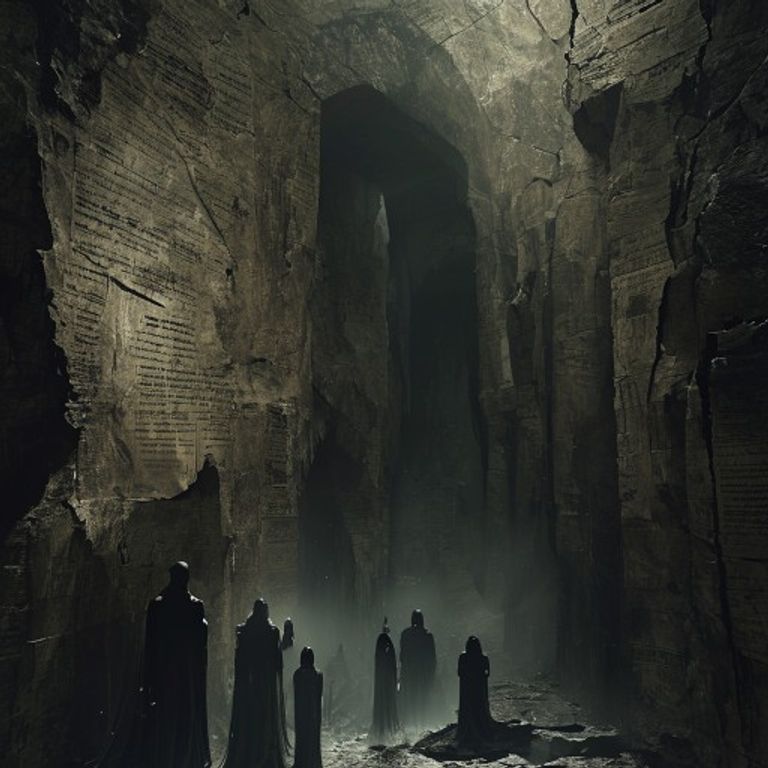
The Whispers Beneath: Unearthing the Mystery of Agartha
Imagine, for a moment, a world hidden just beneath our feet. Not the molten core we learned about in school, but an entire civilization, thriving in a realm untouched by the sun, illuminated by an inner light. A place of unimaginable technology, ancient wisdom, and perhaps, the true origins of humanity. This isn’t science fiction; it’s Agartha, the legendary subterranean kingdom, a mystery whispered across millennia, now, perhaps, on the verge of revealing its deepest secrets. What if everything we thought we knew about our planet was merely the surface of a far grander, more enigmatic truth? Prepare to journey into the heart of a mystery that has captivated emperors, mystics, and even, as we shall soon discover, the most powerful intelligence agencies on Earth.
The Case File: A History of the World Within
The concept of a hidden world beneath our own is not new; it echoes through the annals of human history. From the shimmering, spiritual realm of Shambhala in Tibetan Buddhist tradition to the intricate underworlds of Patalas in Hinduism, and the mythical land of Hyperborea in ancient Greek lore, humanity has long dreamed of secret sanctuaries beyond the reach of surface dwellers. But Agartha, as we understand it today, truly began to take shape in more recent centuries.
The scientific community, surprisingly, was not immune to such speculation. In 1692, the esteemed astronomer Edmond Halley, famous for Halley’s Comet, proposed a radical theory: the Earth was not solid but comprised of concentric spheres, each potentially habitable, with its own atmosphere and even an inner sun. A century later, mathematician Leonhard Euler posited a single, hollow sphere with a central sun providing warmth and light. These were not the musings of madmen, but serious attempts by brilliant minds to explain geomagnetic anomalies and the Earth’s density, albeit with theories that now seem fantastical.
The 19th century saw these scientific curiosities burst into the popular imagination, thanks to literary giants. Jules Verne’s Journey to the Center of the Earth (1864) took readers on an unforgettable expedition through volcanic tubes to a prehistoric subterranean world. Edgar Allan Poe’s chilling Narrative of Arthur Gordon Pym of Nantucket (1838) hinted at a mysterious, warm, and luminous polar region. These weren’t just stories; they were cultural touchstones that embedded the idea of a hidden world deep within the collective consciousness.
The early 20th century saw the emergence of “Agartha” as a specific name, largely popularized by Theosophy. Helena Blavatsky, founder of Theosophy, spoke of hidden masters and secret wisdom. Later, writers like Willis George Emerson, in his 1908 novel The Smoky God, explicitly named “Agartha” and described a Norwegian sailor’s incredible journey through a polar opening into a lush, inner world illuminated by a central ‘smoky’ sun. This narrative, presented as a true account, cemented Agartha’s place in esoteric lore.
Perhaps the most disturbing chapter in Agartha’s story involves the Third Reich. Nazi Germany, particularly through groups like the Thule Society and the Ahnenerbe, harbored a chilling fascination with ancient Aryan roots, occultism, and mythical lands like Shambhala and Agartha. They believed these hidden realms held the key to ultimate power and a superior race. Expeditions were launched to Tibet and Antarctica, reportedly in search of ancient knowledge, mystical artifacts, and even the fabled polar entrances to the inner Earth. The idea of a secret Nazi base in Antarctica, connected to a subterranean world, became a persistent, unsettling whisper.
This brings us to the enigmatic figure of Admiral Richard E. Byrd. His legendary polar expeditions in the 1920s, 30s, and 40s are often cited by Agartha proponents. The persistent rumors of a secret diary, allegedly detailing a flight into the Earth’s interior, encountering advanced beings and a lush, sunlit land, have become a cornerstone of the myth. Then there was Operation Highjump (1946-47), a massive US Navy expedition to Antarctica involving thousands of personnel, multiple ships, and aircraft. Officially, it was for scientific research and establishing a US presence. Unofficially, conspiracy theories suggest a far more clandestine objective: to investigate Nazi remnants, or perhaps, to find the very entrance to Agartha itself. Was Byrd’s mission merely scientific, or was it a covert reconnaissance into the unknown?
The Evidence: Declassified Secrets and Unexplained Phenomena
For decades, the idea of Agartha was largely relegated to the realm of pulp fiction and fringe theories. But what if the very agencies tasked with safeguarding national security were, in their own clandestine ways, exploring the boundaries of human perception and the nature of hidden realities? While no declassified document explicitly states, “We found Agartha!”, a closer look at the intelligence community’s foray into the unexplained offers a tantalizing context.
CIA’s Project Stargate: Peering Beyond the Veil
Consider the CIA’s declassified documents on Project Stargate. From the 1970s through the 1990s, the agency poured millions into “remote viewing” – the alleged ability to perceive distant or unseen targets psychically. While not a direct search for Agartha, these documents, now accessible to the public (e.g., CIA-RDP96-00788R001700210016-5), reveal a fascinating willingness within the intelligence community to explore phenomena beyond conventional science. Remote viewers were tasked with describing everything from secret Soviet military installations to individuals’ whereabouts. If the CIA was seriously investigating individuals who claimed to “see” across continents or into the past, might they not also have entertained the possibility of hidden realms, or sought to “remote view” the Earth’s interior, searching for an informational advantage? The “why” behind this investment wasn’t just idle curiosity; it was a desperate quest for an intelligence edge, a secret weapon in the Cold War. And in a world where information is power, no stone, no matter how esoteric, was left unturned. The very existence of such a project suggests that the line between accepted reality and the truly bizarre was far more permeable within the halls of power than we might imagine.
FBI’s Files on Unidentified Aerial Phenomena: Echoes from Below?
Then there are the FBI’s extensive files on Unidentified Aerial Phenomena, or UAPs, formerly known as UFOs. While often associated with extraterrestrial visitors, some Hollow Earth theories posit that these craft emanate not from distant galaxies, but from the Earth’s interior, piloted by Agarthans or other subterranean civilizations. Declassified FBI memos (e.g., FBI Vault, ‘UFO Part 1 of 1’, Memo from Guy Hottel to Director, FBI, March 22, 1950) detail reports of “flying discs” and “unidentified objects” recovered, even if later debunked or explained. The sheer volume of these investigations, the serious tone of internal communications, and the persistent inability to definitively explain every sighting, left a void that conspiracy theories were eager to fill. If these objects weren’t from space, and weren’t conventional aircraft, where were they from? The FBI’s relentless pursuit of answers, even when those answers remained elusive, inadvertently fueled the very speculation that linked these phenomena to hidden, advanced civilizations, perhaps dwelling beneath the ice caps. The official stance was always one of national security, but the underlying questions about the origin of these mysterious craft continue to resonate with those who believe in a world within our world.
NASA’s Geophysical Surveys: Probing the Planet’s Depths
NASA, the vanguard of space exploration, might seem an unlikely player in the Agartha saga. After all, their satellite imagery definitively shows a solid Earth with no visible polar openings. Yet, their extensive geophysical surveys, gravity mapping, and polar research offer another lens. While the absence of a visible polar opening is often cited as proof against Hollow Earth, for the true believer, it merely shifts the nature of the mystery: perhaps the entrance is cloaked, dimensional, or simply too small to be seen from orbit. What NASA’s documents do reveal (e.g., NASA Technical Reports Server, various reports on gravity anomalies, geomagnetic surveys) is a meticulous, ongoing effort to understand every inch of our planet, from its surface to its deep interior. Anomalies in gravity, unexplained magnetic fluctuations near the poles – these are scientific puzzles that demand further investigation. But to the Agartha theorist, they become potential indicators of something profound, something hidden, a massive, unseen structure or energy source. NASA’s very mandate is to explore the unknown. When they map the deepest trenches, probe the thickest ice sheets, or analyze strange atmospheric phenomena, they are, in a sense, charting the very boundaries of our known world, boundaries that Agartha is said to transcend. The “why” here is pure scientific inquiry, but the implications for those seeking a hidden world are undeniable: if we don’t fully understand our own planet, what else might lie undiscovered, just beneath the surface of our knowledge?
Why Agartha Still Matters Today
Even in our hyper-connected, scientifically advanced age, the myth of Agartha endures. Why? Its appeal is multifaceted. It taps into an enduring human curiosity, the primal desire to believe in something more than the mundane, to uncover a hidden truth that reshapes our understanding of reality. In a world saturated with information, the idea of a secret, pristine world offers a compelling counter-narrative to the complexities and disappointments of modern life.
Agartha, like many grand conspiracy theories, also thrives on a healthy (or sometimes unhealthy) distrust of official narratives. It questions what we’re told by governments and scientific institutions, suggesting that there are deeper truths being withheld. This resonates deeply with those who feel disempowered or disillusioned by mainstream explanations.
Furthermore, the vision of Agartha as a utopian, uncorrupted world resonates powerfully with contemporary environmental concerns. It’s a pristine sanctuary, an escape from our polluted, conflict-ridden surface world. It embodies a longing for a “golden age” or a “lost paradise,” a place where humanity might have evolved differently, free from our current woes. This psychological draw is immense.
Ultimately, whether a physical reality or a magnificent fabrication, the story of Agartha continues to inspire literature, art, and philosophical debate. It reflects our collective unconscious, our anxieties about the future, and our eternal quest for meaning and belonging. It reminds us that even with all our technological prowess, there are still vast, unexplored territories – both within our planet and within the human imagination.
Conclusion: The Unending Quest
So, where does this leave us? Is Agartha a forgotten truth, a spiritual sanctuary, or merely a magnificent fabrication born of human yearning? The declassified documents from the CIA, FBI, and NASA, while not offering a “smoking gun” for Agartha itself, paint a compelling picture of a world where governments do explore the fringes of human understanding, where the unexplained does command serious attention, and where the line between science and speculation can blur. They reveal a landscape of official curiosity about the unknown that, inadvertently or not, fuels the very mysteries they seek to unravel.
Perhaps Agartha isn’t a physical place in the way we imagine, but a powerful metaphor for the vast, unexplored territories within our own planet, our own minds, and our collective history. It represents the ultimate secret, the hidden knowledge we perpetually seek. The true mystery may not be whether Agartha exists, but why we, as humans, are so compelled to believe in it. And as the Earth continues to yield its secrets, one cannot help but wonder: what other astonishing truths lie waiting, just beyond the veil of our perception, perhaps even beneath our very feet, beckoning us to look deeper, to question everything, and to never cease our quest for the unknown?
Researching declassified archives and deciphering ancient secrets requires a lot of time and resources. If you like these stories from the cradle of civilization, support the digital scribe in his further work and buy him a coffee.
Enjoyed this topic? Explore these recommended books for further reading.
Agartha: The Earth's Inner World
Ancient Egipt: Magicians of the Gods
Atlantis: Atlantis and the Ten Plagues of Egypt: The Secret History Hidden in the Valley of the Kings
Lemuria: The Lost Civilization of Lemuria: The Rise and Fall of the World's Oldest Culture
Sumer: The Sumerians: A History From Beginning to End (Mesopotamia History)
Tartaria: The One World Tartarians (Black and White): The Greatest Civilization Ever Erased From History
As an Amazon Associate I earn from qualifying purchases at no extra cost to you. Thank you for your support!