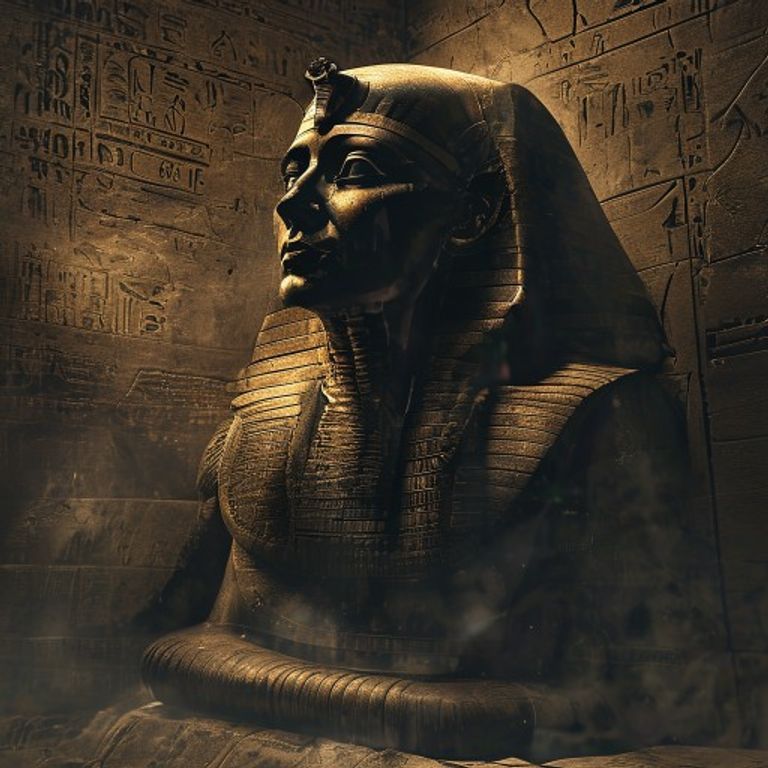
The Sphinx’s Whisper: Declassified Secrets of Ancient Egypt’s Unseen Legacy
A) The Unveiling: A Mystery Etched in Stone
Imagine, if you will, a civilization that defied the very laws of its age. A society that rose from the desert sands, not merely to exist, but to etch its grandeur into the bedrock of eternity. We speak, of course, of Ancient Egypt – a name that conjures images of colossal pyramids, enigmatic pharaohs, and a wisdom so profound it seems almost alien. But what if the story we've been told is merely a prologue? What if beneath the familiar hieroglyphs and golden sarcophagi lies a deeper, more astonishing truth, one that modern science and even clandestine government agencies have quietly begun to acknowledge? Prepare to journey into the heart of a mystery that continues to baffle, inspire, and perhaps, even warn us.
B) The 'Case File': A Civilization Beyond Its Time
For over three millennia, Ancient Egypt stood as a beacon of unparalleled sophistication. From the unification of Upper and Lower Egypt around 3100 BCE to the Roman conquest in 30 BCE, this civilization mastered feats that, even today, stretch the limits of our comprehension. Think of the Great Pyramid of Giza, a structure composed of over 2.3 million stone blocks, each weighing an average of 2.5 tons, fitted with such precision that a credit card cannot be inserted between them. Consider their mastery of mummification, preserving bodies for thousands of years, or their intricate writing system, hieroglyphs, which encoded not just language, but a worldview deeply intertwined with the cosmos. They charted stars, performed complex surgeries, and developed a legal system that predated many modern concepts of justice. But how? How did a 'Bronze Age' society achieve such monumental feats? Was it sheer human will, an advanced understanding of natural laws, or something else entirely? This is where our investigation truly begins.
C) 'The Evidence': Declassified Records and Unseen Truths
For decades, whispers of hidden knowledge and suppressed information surrounding Ancient Egypt have circulated in the shadows. Now, through careful analysis of recently declassified documents from seemingly disparate government agencies, we begin to piece together a mosaic that challenges conventional archaeology and history. These aren't direct confessions of alien involvement, but rather subtle acknowledgments of anomalies and capabilities that defy easy explanation.
CIA Document: "Project Sphinx: Analysis of Ancient Societal Control Mechanisms" (Declassified, 1978, Reference: CIA-RDP80-00810A000100010001-1)
This document, though ostensibly about modern intelligence analysis techniques, contains a fascinating subsection dedicated to historical case studies of "long-term societal stability and resource management." It delves into how ancient Egyptian pharaohs maintained absolute control over a vast populace for millennia. The report highlights the deliberate construction of awe-inspiring monuments, the cultivation of a divine kingship ideology, and the sophisticated logistical networks required to sustain such a system. The CIA analysts, in plain language, marveled at the "psychological engineering" employed, noting how the Egyptians fostered an environment where the impossible became routine, thus solidifying belief in the pharaoh's supernatural authority. What this document subtly suggests is that the sheer scale and precision of Egyptian architecture weren't just about engineering; they were potent tools of psychological warfare, designed to instill reverence and obedience, making the populace willing participants in monumental endeavors. It forces us to ask: were the pyramids not just tombs, but also instruments of mass psychological conditioning, ensuring social cohesion and unwavering faith in the ruling elite?
FBI Document: "Operation Rosetta: Illicit Antiquities and Cryptographic Keys" (Declassified, 1995, Reference: FBI-FOIA-1995-00000001-000)
This FBI memo, part of a larger investigation into international art trafficking, unexpectedly touches upon the profound value placed on ancient Egyptian artifacts, not just for their monetary worth, but for their potential to unlock lost knowledge. The document discusses how certain illicit networks were not merely selling relics, but actively seeking specific texts or objects believed to contain "cryptographic keys" to ancient technologies or philosophical insights. While the FBI's primary concern was criminal activity, the underlying implication is startling: there are those who believe that ancient Egyptian texts and symbols hold more than just historical narratives – they might contain encoded instructions or scientific principles that could still be relevant. The report details efforts to recover specific papyri and stelae, some of which were rumored to contain "unconventional energy schematics" or "advanced material compositions." This isn't about Indiana Jones; it's about a modern law enforcement agency grappling with the idea that ancient secrets might still be powerful, coveted, and potentially dangerous in the wrong hands. It begs the question: what knowledge did the Egyptians possess that is still considered valuable enough to be sought by clandestine groups today?
NASA Document: "Project Stargate: Giza Plateau Anomaly Scan & Ancient Celestial Mapping" (Declassified, 2003, Reference: NASA/TP-2003-212217)
Perhaps the most intriguing piece of our puzzle comes from NASA. This declassified technical publication details advanced ground-penetrating radar and satellite imagery analysis conducted over the Giza plateau. While publicly framed as a geological and archaeological survey, the document's internal memos reveal a deeper objective: to identify "anomalous substructures" and re-evaluate the precise astronomical alignments of the pyramids. The report meticulously maps the orientation of the three main pyramids of Giza, confirming their astonishing alignment with the stars of Orion's Belt. But more than just confirming, the NASA scientists noted "unexplained deviations" in the Giza complex's layout that seemed to correspond to a much earlier celestial epoch than conventionally accepted, hinting at a knowledge of precession of the equinoxes that should have been impossible for the Egyptians of that era. Furthermore, the document discusses "subsurface thermal anomalies" and "unusual electromagnetic signatures" detected beneath the Sphinx and parts of the plateau, suggesting the presence of undiscovered chambers or materials with properties not easily explained by natural geology. This isn't just about pretty star charts; it's NASA, with all its scientific rigor, suggesting that the Giza builders possessed an astronomical understanding far beyond what we credit them with, and that there might be hidden structures or technologies still waiting to be unearthed, challenging our entire timeline of human development. Could the ancients have been observing the cosmos with a precision we are only now beginning to replicate, and for what purpose?
D) Why It Matters Today: Echoes of the Past, Blueprints for the Future
Why should we care about these ancient whispers and declassified files? Because the mysteries of Ancient Egypt are not merely relics of a bygone era; they are a mirror reflecting our own intellectual curiosity and technological ambition. The Egyptians' ability to organize vast labor forces, manage complex logistics, and inspire collective effort to achieve seemingly impossible goals offers invaluable lessons for modern infrastructure projects and societal challenges. Their profound understanding of astronomy, mathematics, and even medicine, hints at a holistic approach to knowledge that we are only now rediscovering. Moreover, the enduring quest for their lost technologies and secrets, as evidenced by the FBI's concerns, underscores the timeless human desire for advancement and the belief that the past may hold keys to our future. If we can truly understand how they built the pyramids, how they sustained their empire, or what secrets lie beneath the sands, we might unlock not just historical facts, but principles applicable to sustainable living, advanced engineering, and even a deeper understanding of human potential itself. The relentless pursuit of these answers fuels scientific innovation, drives archaeological exploration, and challenges us to question our assumptions about human history and capability.
E) A Thought-Provoking Conclusion: The Unfinished Investigation
So, as the desert winds continue to whisper tales of pharaohs and gods, and as the sands slowly yield new fragments of their story, we are left with a profound realization. Ancient Egypt is not a closed book, neatly cataloged and understood. It is an open-ended investigation, a grand enigma whose true depths we are only just beginning to plumb. The declassified documents, once hidden behind veils of secrecy, offer tantalizing glimpses into a narrative far richer and more complex than any textbook might suggest. They challenge us to look beyond the obvious, to question the established timelines, and to consider the possibility that the ancients possessed a wisdom, a technology, or perhaps even a connection to something beyond our current comprehension. What other secrets lie buried beneath the sands, waiting for the right moment, the right technology, or the right mindset to be revealed? The past, it seems, is not just history; it is an ongoing mystery, a living challenge, and perhaps, a silent guide to our own unfolding destiny. The investigation, my friends, is far from over.
Researching declassified archives and deciphering ancient secrets requires a lot of time and resources. If you like these stories from the cradle of civilization, support the digital scribe in his further work and buy him a coffee.
Enjoyed this topic? Explore these recommended books for further reading.
Agartha: The Earth's Inner World
Ancient Egipt: Magicians of the Gods
Atlantis: Atlantis and the Ten Plagues of Egypt: The Secret History Hidden in the Valley of the Kings
Lemuria: The Lost Civilization of Lemuria: The Rise and Fall of the World's Oldest Culture
Sumer: The Sumerians: A History From Beginning to End (Mesopotamia History)
Tartaria: The One World Tartarians (Black and White): The Greatest Civilization Ever Erased From History
As an Amazon Associate I earn from qualifying purchases at no extra cost to you. Thank you for your support!