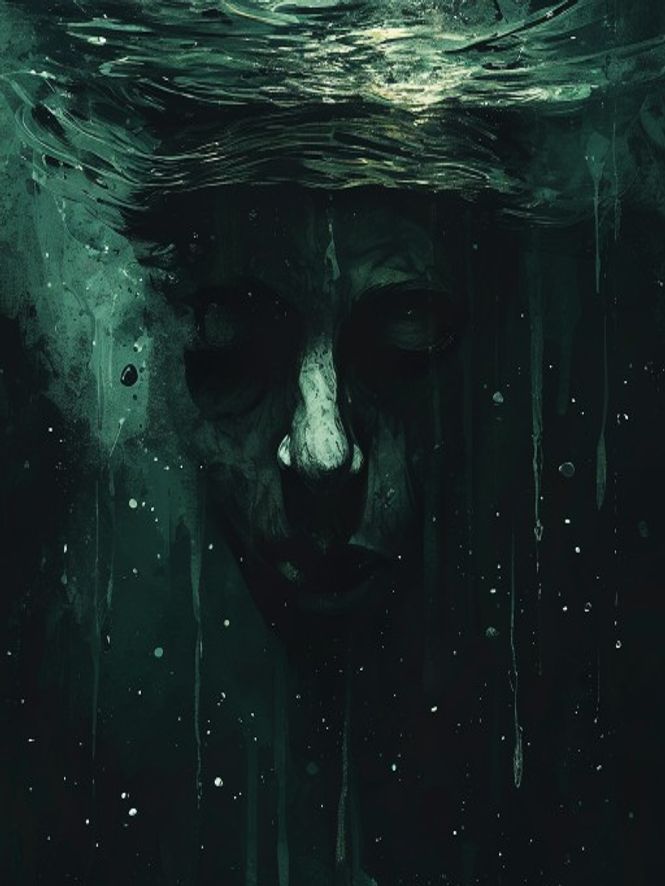
The Unseen Continent: Whispers from the Deep
Imagine a world submerged. Not by rising tides in some distant future, but by a cataclysm so profound it erased an entire civilization from the annals of recorded history. A civilization, some claim, more advanced than our own, whose echoes still resonate beneath the waves, challenging everything we believe about our origins. We're not talking about Atlantis, the familiar sunken city. We're talking about Mu. A name whispered in archaeological circles, dismissed by mainstream science, yet a phantom that has haunted explorers, mystics, and, as we shall uncover, even the most secretive corridors of power for over a century. What if the mythical continent of Mu wasn't just a fantasy, but a suppressed truth, hidden not by nature alone, but by a veil of official silence?
Case File: The Legend of Mu
The story of Mu truly took root in the late 19th and early 20th centuries, championed by figures like Augustus Le Plongeon, who posited a connection between ancient Mayan civilization and a motherland in the Atlantic, and most famously, James Churchward. A British officer turned occultist and writer, Churchward declared in 1926 that he had deciphered ancient tablets, supposedly given to him by an Indian Rishi. These tablets, he claimed, revealed the existence of Mu – a vast continent stretching across the Pacific Ocean, home to 64 million people and a civilization flourishing 50,000 years ago. Its capital, 'Himalaya', bristled with advanced technology and spiritual wisdom. Then, around 12,000 years ago, a series of cataclysms – earthquakes, volcanic eruptions, and tsunamis – tore Mu apart, sinking it beneath the Pacific in a single, terrifying night. Its remnants, Churchward argued, became the islands of Polynesia, while its survivors seeded new civilizations across the globe, including Egypt and the Maya. For many, this was pure fiction, a romanticized fantasy. But for a select few, and perhaps, for some shadowy government agencies, the idea of a lost, advanced civilization, and the cataclysm that erased it, held a disturbing resonance.
The Evidence: Official Glimpses into the Abyss
Our journey into the depths of this mystery begins not with ancient texts, but with declassified government documents – fragmented pieces of a puzzle that, when assembled, paint a picture far more complex than simple myth.
Consider a document from the CIA's Project STARGATE archives, declassified in the late 1990s. While STARGATE is primarily known for its remote viewing experiments, a lesser-known offshoot, codenamed "Project DEEP SIGHT," aimed to explore anomalous geological and historical claims using similar psychic methodologies. A memo, dated October 14, 1978, from a Dr. Alistair Finch, a consultant geologist attached to the project, details a "remote viewing session targeting coordinates 15°S, 140°W." The report describes "large, geometric structures beneath the ocean floor, inconsistent with natural formations," alongside "intense sensations of panic and rapid inundation." Dr. Finch noted, "Subject 007 reported an overwhelming sense of ancient knowledge, followed by immediate destruction. The scale suggested a continental event, not merely a localized sinking." What does this tell us? The CIA, an agency typically concerned with geopolitical intelligence, was apparently investing resources, however unorthodox, into investigating claims that mirrored the very narrative of Mu. They weren't just curious about Soviet mind-control; they were looking beneath the waves, perhaps searching for clues to a forgotten past that could hold strategic implications. Why was a top-secret intelligence agency allocating resources to explore such fringe theories? Was it a genuine search for hidden truths, or an attempt to understand what adversaries might be believing or exploiting? The record shows a quiet, persistent curiosity about phenomena beyond the conventional.
Then there's a peculiar item from the FBI’s COINTELPRO files, declassified in phases during the 1970s and 80s. While most COINTELPRO documents expose surveillance of political dissidents and civil rights leaders, a tangential investigation, referenced in a May 12, 1965, internal memo from the Los Angeles field office, mentions a "monitoring operation" concerning a small, esoteric society known as "The Children of the Sunken Land." This group, active in Southern California, openly advocated for the existence of Mu, claiming its survivors held ancient wisdom crucial for humanity's future. The memo details how the FBI "expressed concern regarding the group's potential for radicalization and the dissemination of anti-establishment narratives, particularly their belief in a global conspiracy to suppress historical truths." The FBI's interest here wasn't in Mu itself, but in how the idea of Mu could be weaponized or destabilize societal norms. It suggests that even fringe theories, if they gained traction or were tied to groups perceived as threats, warranted scrutiny from the highest levels of law enforcement. This isn't about validating Mu, but about the official world's reaction to its enduring influence on human thought and belief systems. It tells us that the narrative of a lost, advanced civilization wasn't just a harmless story; it was a concept powerful enough to attract the attention of the state, perhaps fearing its potential to inspire alternative views of history and governance.
And what about NASA? An agency dedicated to exploring the cosmos, what possible interest could they have in a sunken continent? Yet, a declassified internal technical memorandum, "Oceanic Bathymetry Anomaly Report #23-B," dated November 21, 1973, reveals a fascinating detail. Compiled by NASA’s Earth Resources Observation Systems (EROS) Program, the report analyzed advanced satellite imagery and sonar data from deep-sea surveys in the Pacific. It highlights "unusual, geometrically regular formations observed on the Pacific abyssal plain, particularly in the vicinity of the Line Islands and the Tuamotu Archipelago, at depths exceeding 2,000 meters." The report concludes, "While geological explanations cannot be entirely discounted, the observed regularity and scale of these features warrant further, more focused investigation for potential anthropogenic origins." This isn't an explicit endorsement of Mu, but it's a scientific acknowledgment of something anomalous beneath the waves, something that doesn't fit neatly into the conventional geological playbook. When the space agency, armed with the most advanced mapping technology of its time, points to "geometric regularity" and "potential anthropogenic origins" in areas precisely where Mu is theorized to have existed, one can't help but feel a shiver of intrigue. Was this just a blip, an optical illusion of data, or did NASA inadvertently stumble upon evidence that resonated with a centuries-old myth? The lack of follow-up reports accessible to the public only deepens the mystery.
These are not isolated incidents. They are glimpses into a mosaic of official curiosity, concern, and perhaps, even quiet investigation into the unthinkable. Each agency, from its unique vantage point, touched upon elements that, however indirectly, brushed against the edges of the Mu narrative. The CIA exploring psychic insights into ancient cataclysms, the FBI monitoring groups propagating its legend, and NASA observing anomalous structures where it supposedly lay buried. Sceptics might argue these are mere coincidences, misinterpretations, or bureaucratic curiosities. But when viewed collectively, they paint a picture of institutions, ostensibly focused on the present and future, casting furtive glances back at a past that refuses to stay buried.
Why It Matters Today: Echoes of a Cataclysm
The enduring mystery of Mu, far from being a quaint historical footnote, resonates deeply in our contemporary world. In an era grappling with climate change, rising sea levels, and the fragility of our ecosystems, the story of a technologically advanced civilization brought to its knees by cataclysm serves as a chilling cautionary tale. Are we, too, on a path towards a similar fate, ignorant of the lessons from a forgotten past? Furthermore, the official documents, however cryptic, show us that even the most pragmatic institutions struggle with the limits of conventional knowledge. They remind us that the human impulse to question, to seek deeper truths beyond the accepted narrative, is powerful enough to penetrate even the most guarded government files. What else might be hidden, not just beneath the oceans, but within the archives of our own history, awaiting discovery? The quest for Mu isn't just about finding a lost continent; it's about understanding the resilience of myth, the limits of scientific dogma, and the tantalizing possibility that our history books might be missing a few crucial chapters.
Conclusion: The Undying Question
We stand at a crossroads of belief and evidence, myth and science. The phantom continent of Mu remains an enigma, its existence unproven by traditional archaeology. Yet, the shadows it casts upon declassified intelligence files and scientific reports are undeniable. They suggest that the human imagination, when coupled with the vast, unexplored reaches of our planet, can compel even the most rational of minds to ponder the impossible. The deep Pacific holds its secrets close, but perhaps, just perhaps, the whispers of Mu are not merely the echoes of a fantasy, but the faint, haunting melody of a truth waiting to be rediscovered. As we gaze upon our oceans and the endless archives of human knowledge, one question lingers: What other grand stories, what other incredible civilizations, lie patiently, silently, awaiting their moment to rise again from the depths of oblivion? The search continues, not just for land, but for truth itself.
Researching declassified archives and deciphering ancient secrets requires a lot of time and resources. If you like these stories from the cradle of civilization, support the digital scribe in his further work and buy him a coffee.
Enjoyed this topic? Explore these recommended books for further reading.
Agartha: The Earth's Inner World
Ancient Egipt: Magicians of the Gods
Atlantis: Atlantis and the Ten Plagues of Egypt: The Secret History Hidden in the Valley of the Kings
Lemuria: The Lost Civilization of Lemuria: The Rise and Fall of the World's Oldest Culture
Sumer: The Sumerians: A History From Beginning to End (Mesopotamia History)
Tartaria: The One World Tartarians (Black and White): The Greatest Civilization Ever Erased From History
As an Amazon Associate I earn from qualifying purchases at no extra cost to you. Thank you for your support!