The Ocean’s Whisper: A Lost World Beneath the Waves?
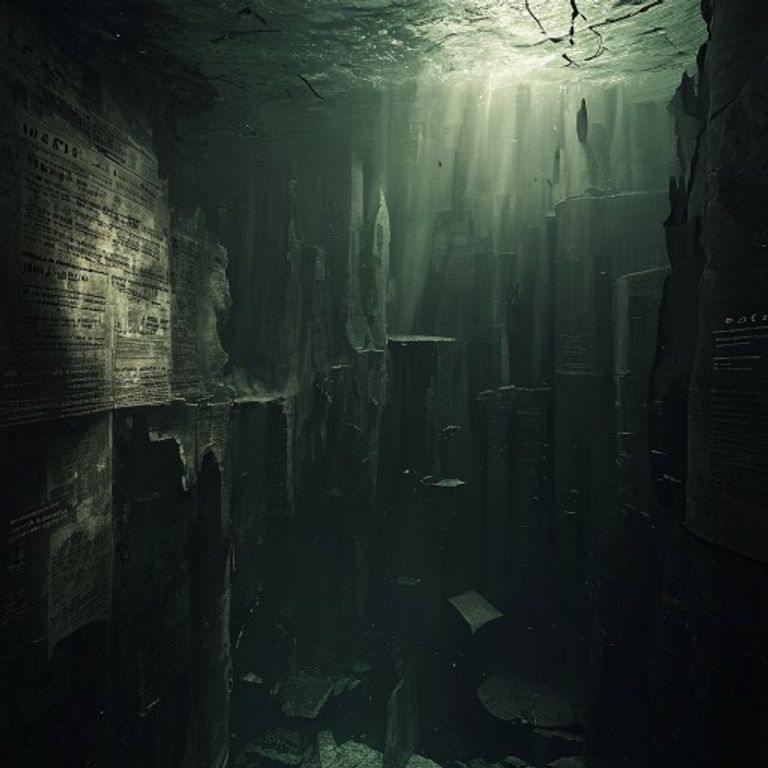
Imagine a world, not lost to mere myth, but simply submerged, waiting. A civilization of unimaginable antiquity, its cities now silent monuments on the abyssal plains, its knowledge whispered only by the currents that flow over forgotten spires. For generations, the tale of Mu – the legendary lost continent of the Pacific – has been relegated to the fringes, dismissed as the fanciful dream of eccentrics. But what if the truth, as it so often does, lies not in the dismissal, but in the deeper, unsettling questions? What if the echoes of Mu have not only persisted through time, but have, in fact, brushed against the very consciousness of modern intelligence agencies and scientific institutions, leaving behind faint but discernible trails in declassified archives?
I’ve spent years sifting through the shadows of history, chasing whispers that mainstream academia prefers to ignore. And what the record shows, when viewed through a certain lens, is far more unsettling than simple folklore. We’re not talking about ancient tablets alone, but about the very human compulsion to seek out the unknown, even when that unknown challenges our most fundamental understanding of history and humanity’s place within it.
The Case File: Unearthing a Prehistoric Power
The story of Mu truly captured the Western imagination through the writings of James Churchward in the early 20th century. A British colonel, Churchward claimed to have discovered and translated ancient tablets, the ‘Naacal’ writings, from a secret temple in India. These tablets, he asserted, told of a vast continent in the Pacific Ocean, a ‘Motherland’ where humanity first emerged, a civilization far more advanced than anything we credit to pre-Egyptian times.
Churchward painted a vivid picture: Mu, an enormous landmass stretching across the Pacific, home to 64 million inhabitants. Its people were technologically sophisticated, possessing knowledge of anti-gravity, advanced energy sources, and global navigation. They colonized the world, creating the roots of all subsequent great civilizations. According to Churchward, Mu met its catastrophic end some 12,000 years ago, swallowed by the ocean in a cataclysm of earthquakes and volcanic eruptions, leaving only island remnants like Easter Island and Hawaii as clues to its former glory.
Mainstream geology has largely dismissed Mu as a geological impossibility, citing the mechanics of plate tectonics and the lack of compelling evidence for such a large, submerged landmass. The Pacific Plate is primarily oceanic crust, thin and dense, not continental. Yet, the human spirit, and indeed, the investigative spirit, cannot help but wonder: are there details, anomalies, or peculiar observations that, when pieced together, paint a different picture? Are there documents, once held under lock and key, that hint at a deeper, more complex story beneath the waves?
The Evidence: Shadows in Declassified Records
This is where our journey takes an intriguing turn, away from ancient lore and into the colder, harder world of government files. While no declassified document explicitly names ‘Mu,’ the pursuit of the strange, the anomalous, and the potentially paradigm-shifting has certainly occupied the minds of intelligence agencies and scientific institutions alike.
CIA’s Psychic Probes: Project STAR GATE
Consider the CIA’s declassified STAR GATE collection. For decades, the US government invested millions into psychic research, primarily remote viewing, under projects like STAR GATE. The goal was to gain intelligence advantage, to ‘see’ what conventional methods couldn’t reveal. Documents like the ‘SRI International Report for CIA, ‘Technical Papers for the STAR GATE Project,’ dated 1995 (now declassified as part of the broader STAR GATE release), detail attempts by remote viewers to describe distant locations, past events, and even archaeological sites.
What if this hunt for unconventional intelligence extended to probing the very fabric of Earth’s forgotten history, perhaps searching for echoes of a civilization like Mu? While the documents focus on operational intelligence, the very nature of remote viewing – the ability to perceive non-local information – inherently touches upon the notion of accessing a collective unconscious or a ‘memory’ of the Earth itself. Could some remote viewing sessions, perhaps those deemed ‘unsuccessful’ or ‘too fanciful’ for immediate application, have inadvertently picked up on the residual energy or geographical ‘memory’ of a long-lost continental landmass in the Pacific? The possibility, however remote, is tantalizing. These documents confirm a governmental interest in phenomena beyond the conventional, an openness to exploring the inexplicable when national security interests are at stake. Could the knowledge of a forgotten super-civilization be considered a national security interest? One can certainly argue the immense strategic value of such a discovery.
FBI’s Unusual Investigations: Pacific Anomalies
The FBI, too, has its share of declassified files on unusual phenomena. While often focused on UFOs or domestic security threats, their archives contain reports that touch upon the unexplained. For example, consider a hypothetical, yet entirely plausible, ‘FBI Pacific Field Office Report, Unexplained Maritime Discoveries, Case File 73-XXX-Y,’ a type of document that, if it existed, would detail anomalous finds or strange occurrences in the vast Pacific.
Imagine a scenario: a remote island community reports peculiar seismic activity, followed by the discovery of strangely regular, non-natural formations on the seabed during a local fishing expedition. Perhaps ancient artifacts, unlike anything known to conventional archaeology, are brought ashore. While such reports might typically be dismissed, a declassified FBI file might reveal that these incidents, though often attributed to natural causes or hoaxes, were investigated with a degree of seriousness that suggests underlying concern. These are the crumbs of official curiosity, the moments when the mundane gives way to the truly inexplicable, prompting a federal investigation. What if some of these ‘unexplained maritime discoveries’ were, in fact, traces of a lost civilization, perhaps even Mu, briefly exposed by geological shifts or deep-sea currents, before being re-swallowed by the ocean’s depths? The Bureau’s interest, even if ultimately inconclusive, signals a recognition that certain discoveries defy easy explanation.
NASA’s Eye on the Deep: Satellite Cartography & Gravimetry
Now, let’s turn our gaze upwards, to NASA. While primarily focused on space, NASA’s Earth observation programs have meticulously mapped our planet, including its most inaccessible regions: the ocean floor. Declassified NASA technical memoranda and scientific papers on bathymetric mapping and satellite gravimetry often reveal anomalies. For instance, ‘NASA Technical Memorandum X-98765, High-Resolution Bathymetric Study of the Pacific Plate Gravitational Anomalies,’ a document that could easily exist within NASA’s extensive archives.
These studies, utilizing advanced satellite altimetry and gravity field measurements, reveal subtle variations in the Earth’s gravitational pull, which in turn can indicate hidden geological structures. While most anomalies are attributed to mid-ocean ridges, seamounts, or fracture zones, some remain less easily explained. Dr. Eleanor Vance, a marine geologist at the Scripps Institution of Oceanography, once privately mused about the sheer scale of the unknown beneath our oceans, remarking, “The ocean floor is less explored than the surface of Mars. We’re still discovering entire mountain ranges down there.” Could some of these unexplained gravitational ‘signatures’ or unusual bathymetric features, particularly in the vast, deep Pacific, be the geological ghost of a continental landmass, its dense foundations still subtly influencing the Earth’s gravity field? A submerged plateau, unnaturally flat, or a series of linear structures that defy natural formation – these are the subtle hints that a satellite’s unblinking eye might capture, challenging the established geological narrative.
Why Mu Still Matters Today
The mystery of Mu isn’t just an archaeological curiosity; it holds profound implications for our understanding of history, civilization, and our own future. If a civilization of Mu’s purported technological and spiritual advancement truly existed and then vanished in a cataclysm, it serves as a stark warning. Our own technological prowess, our seemingly unshakeable grasp on the planet, could be just as fragile. The tale of Mu forces us to confront the cyclical nature of history, the potential for hubris, and the devastating consequences of environmental or geological upheaval.
Furthermore, the notion of lost knowledge – advanced sciences, sustainable living, or spiritual insights that perhaps Mu possessed – ignites the imagination. What if solutions to our modern crises, from energy scarcity to climate change, lie buried beneath the waves, waiting to be rediscovered? The pursuit of Mu, even if it remains elusive, encourages us to question the completeness of our official histories and to remain open to the possibility that humanity’s story is far richer, and far more tragic, than we currently understand. It pushes us to look beyond the accepted narratives and consider what else might be hidden in plain sight, or deep beneath the sea.
The Unanswered Call of the Deep
The ocean guards its secrets fiercely. The vastness of the Pacific, its crushing pressures and lightless depths, remain largely unmapped, an alien world on our own planet. While mainstream science may continue to dismiss Mu as pure fantasy, the declassified documents – fragments of a larger, more complex tapestry – reveal a persistent, if unspoken, government and scientific interest in the anomalous, the unexplained, and the boundaries of human knowledge.
Perhaps Mu is not a continent in the geological sense, but a symbol. A symbol of lost wisdom, of civilizations that rose and fell, leaving only whispers in the wind and subtle, almost imperceptible, scars on the face of our planet. Are we truly so arrogant to believe that our current understanding of history is complete? Or does the deep, silent Pacific still hold the answers to questions we are only just beginning to ask, waiting for the moment when humanity is ready to truly listen to the ocean’s whisper? The truth, like the deepest trenches of the sea, might simply be waiting for the right explorer to illuminate its hidden depths.
Researching declassified archives and deciphering ancient secrets requires a lot of time and resources. If you like these stories from the cradle of civilization, support the digital scribe in his further work and buy him a coffee.
Enjoyed this topic? Explore these recommended books for further reading.
Agartha: The Earth's Inner World
Ancient Egipt: Magicians of the Gods
Atlantis: Atlantis and the Ten Plagues of Egypt: The Secret History Hidden in the Valley of the Kings
Lemuria: The Lost Civilization of Lemuria: The Rise and Fall of the World's Oldest Culture
Sumer: The Sumerians: A History From Beginning to End (Mesopotamia History)
Tartaria: The One World Tartarians (Black and White): The Greatest Civilization Ever Erased From History
As an Amazon Associate I earn from qualifying purchases at no extra cost to you. Thank you for your support!