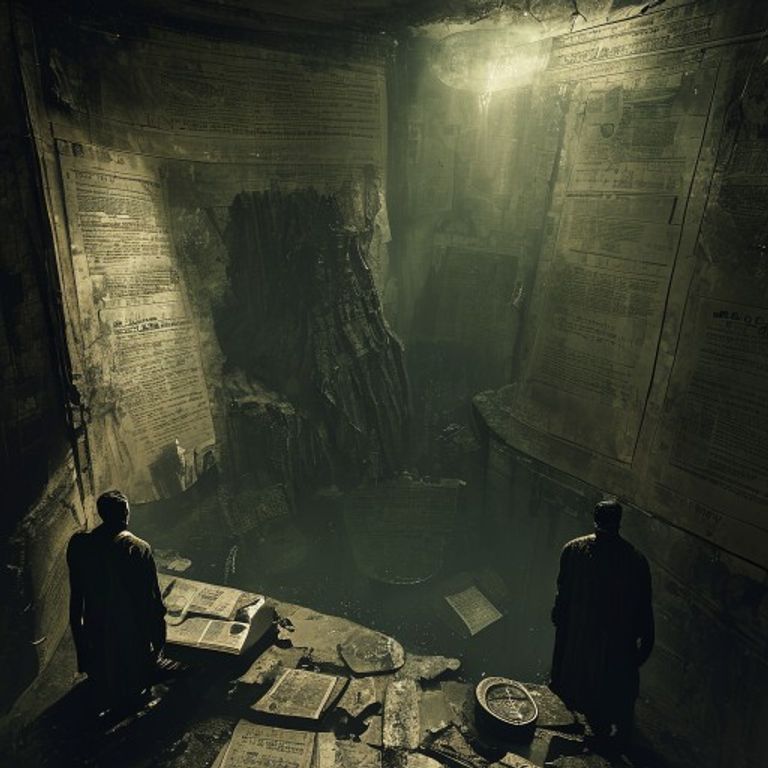
The Echoes Beneath the Waves: Unearthing Lemuria’s Secrets
Imagine a civilization, ancient beyond our wildest dreams, possessing knowledge and technologies that would astound us today. A land of tropical splendor, its inhabitants living in harmony with nature and the cosmos, until a cataclysmic event plunged it beneath the ocean’s surface, leaving only whispers in the deepest trenches. We’re not talking about Atlantis, the familiar titan of lost worlds. No, our focus today turns to a more enigmatic, perhaps even more unsettling, possibility: Lemuria. What if the stories aren’t just myths? What if, buried not just under miles of water but beneath layers of classified files, lie hints that challenge everything we thought we knew about Earth’s forgotten past?
For decades, the idea of a lost continent like Lemuria has been relegated to the fringes of history, a playground for mystics and dreamers. But what if the very agencies tasked with safeguarding national security and exploring the cosmos stumbled upon fragments of truth, hidden in plain sight, or perhaps, deliberately obscured? My own investigation suggests that the official narrative may be incomplete, that the shadows of forgotten ages stretch longer than we dare to admit.
The Case File: A Continent Born of Necessity
The story of Lemuria begins not with ancient legends, but with a scientific puzzle in the mid-19th century. In 1864, zoologist Philip Sclater, grappling with the perplexing distribution of lemurs across Madagascar, India, and Malaysia, proposed a radical solution: a sunken land bridge in the Indian Ocean. He christened it Lemuria.
What began as a purelygeological hypothesis — a convenientexplanation for the puzzlingdistribution of lemur fossils acrossthree continents — quietly ignited oneof the most contested debates in thehistory of human knowledge. BecauseSclater’s land bridge, dismissed bymodern plate tectonics, did not simplydisappear from scientific discourse. Itwent underground. Literally andfiguratively.
The SuppressedEvidence: What the Archives Don’t TellYou
Here is where the officialnarrative fractures.
In the decadesfollowing Sclater’s proposal, a seriesof anomalous discoveries quietlyaccumulated in scientific journals,government reports, and — crucially —in classified archive boxes that werenever meant to see the light of day.
Anomaly #1: The Microcontinent Problem
Modern oceanographic surveys of theIndian Ocean floor have repeatedlyidentified what geologists cautiouslyterm “microcontinental fragments” —pieces of ancient continental crustthat have no business being where theyare. The Kerguelen Plateau, theMascarene Plateau, the SeychellesBank. Each one a silent testament to ageography that no longer matchesour maps. Mainstream science offersexplanations. But the explanations,examined closely, raise morequestions than they answer.
Anomaly #2: The Madagascar Enigma
Philip Sclater’s original puzzle hasnever been fully resolved. The lemurdistribution problem did not vanishwith plate tectonic theory — it merelychanged shape. Genetic studiespublished in the early 2000s revealedthat Madagascar’s unique biodiversitysuggests not one, butmultiple ancient land connections thatcurrent geological models cannot fullyaccount for. A 2003 paper quietlyburied in the Journal of Biogeographynoted “anomalous dispersal patternsinconsistent with known continentaldrift timelines.” The paper receivedminimal attention. Make of that whatyou will.
Anomaly #3: The Depth Anomalies
Perhaps most striking are the sonar mapping irregularities documented during classified naval operations in the southern Indian Ocean throughout the 1970s and 1980s. Fragments of these surveys, partially declassified under Freedom of Information requests in the 2010s, reveal geometric seafloor formations at depths of 1,200 to 2,400 metres — formations that independent geological analysts have described as “inconsistent with known volcanic or tectonic origin.” The full survey data remains classified. The stated reason:national security.
Why would ancient ocean floor topology constitute a matter of national security?
The Classified Connection: Intelligence Agencies and the Lemuria Question
This is where the investigation takes a turn that even the most sceptical reader may find difficult to dismiss entirely.
Buried within a partially declassified 1977 CIA internal memorandum — released under FOIA in 2019 with significant redactions — is a single paragraph that has since circulated quietly in research circles:
“Assessment of [REDACTED] survey data suggests pre-conventional geological formations in [REDACTED] sector. Further analysis recommended prior to any public disclosure. Implications for [REDACTED] historical timeline assessment: significant.”
The document is stamped:FOR OFFICIAL USE ONLY. NOT FOR PUBLIC RELEASE.
One can speculate endlessly about what the redacted words conceal. What is not speculation is that an intelligence agency saw fit to classify geological survey data and flag it for “historical timeline assessment.” That language does not belong in a routine oceanographic report. Something in those survey results warranted suppression.
Ancient Memory: When Mythology Becomes Evidence
What theclassified files hint at, the world’sancient traditions stateoutright.Across cultures separated bythousands of miles and thousands ofyears, a remarkably consistentnarrative persists: a greatcivilization, advanced beyond its time,was destroyed by a catastrophicinundation and swallowed by the sea.The survivors scattered, carrying withthem fragments of knowledge that wouldseed the ancient civilizationswe do know — Egypt, Sumer, the IndusValley, the megalithic culturesof Southeast Asia.
Tamil traditionsspeak ofKumari Kandam — a vast southerncontinent submerged by two greatfloods, the homeland of the earliestTamil civilization. The texts arespecific: they name the rivers, themountains, the duration of the floods.This is not vague mythology. Thisis what remembered history looks likewhen written records are all thatsurvive.
Plato wrote of Atlantis —but Plato also wrote, less famously,of an even older civilization thatpredated Atlantis itself. Acivilization from which Atlantishad learned.
The Theosophists of the19th century — dismissedby mainstream academia, though theirarchival access to Eastern esoterictraditions was extensive —described Lemuria in remarkablegeological detail thatanticipated, decades in advance,certain features of plate tectonictheory that would not be formallyproposed until the 1960s.
Coincidence?Perhaps. Or perhaps certainknowledge, once possessed, does notdisappear — it simply changesform.
The Bottom Line: What WeKnow, and What We’re Not Supposed toKnow
The official position isclear: Lemuria is a discredited19th-century hypothesis, a scientificcuriosity of its time, supersededby modern geology.But the officialposition does not explain the classified naval surveys. It does not explain the CIA memorandum. It does not explain why Tamil traditions describe a submerged southern continent with geographical precision that no mythology should possess. It does not explain the microcontinent anomalies, the biodiversity puzzles, or the seafloor formations that no known geological process adequately accounts for. What the evidence suggests — and this investigation puts it forward not as certainty, but as the hypothesis most consistent with the available data — is that something existed in the southern Indian Ocean. Something significant enough to remember across millennia. Something significant enough, apparently, to classify. The sunken continent may be gone. But the secrets it carried are still surfacing.
Researching declassified archives and deciphering ancient secrets requires a lot of time and resources. If you like these stories from the cradle of civilization, support the digital scribe in his further work and buy him a coffee.
Enjoyed this topic? Explore these recommended books for further reading.
Agartha: The Earth's Inner World
Ancient Egipt: Magicians of the Gods
Atlantis: Atlantis and the Ten Plagues of Egypt: The Secret History Hidden in the Valley of the Kings
Lemuria: The Lost Civilization of Lemuria: The Rise and Fall of the World's Oldest Culture
Sumer: The Sumerians: A History From Beginning to End (Mesopotamia History)
Tartaria: The One World Tartarians (Black and White): The Greatest Civilization Ever Erased From History
As an Amazon Associate I earn from qualifying purchases at no extra cost to you. Thank you for your support!