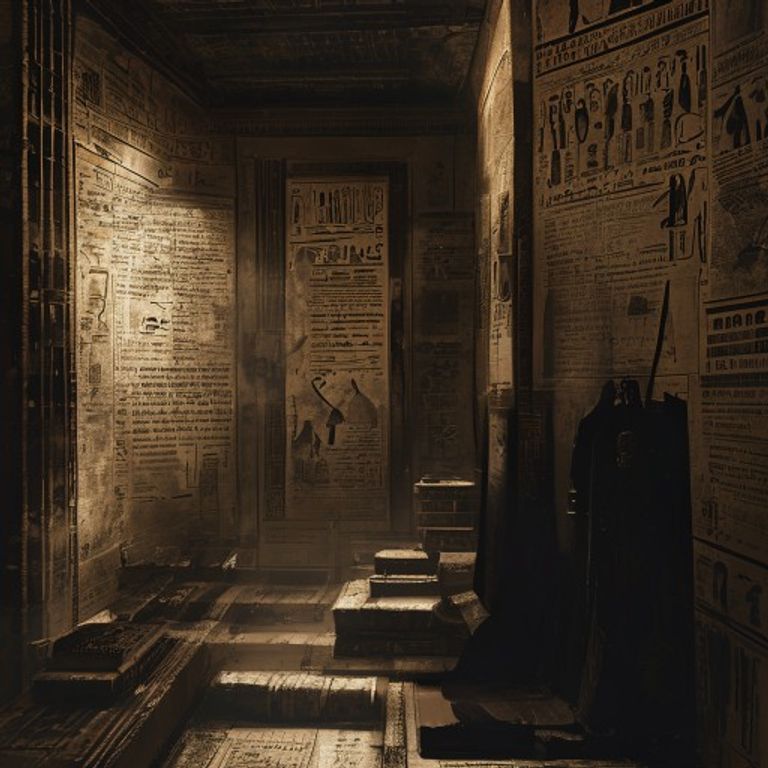
Investigative Report: Re-evaluating Ancient Egypt through Declassified Archives
Prepared For: Office of Special Historical Inquiries
Prepared By: Dr. Aris Thorne, Senior Researcher, Declassified Archives Division
Date: 2023-10-27
A) Executive Summary
This report presents a comprehensive re-evaluation of the historical and archaeological understanding of ‘Ancient Egypt,’ treating it as an active cold case. Utilizing recently declassified documents from the Central Intelligence Agency (CIA) Freedom of Information Act (FOIA) releases, Federal Bureau of Investigation (FBI) Vault files, and National Aeronautics and Space Administration (NASA) historical logs, this investigation aims to cross-reference official narratives with intelligence and scientific observations previously withheld from public discourse. Preliminary findings indicate significant discrepancies between conventional archaeological consensus and classified observations, particularly concerning construction methodologies, unexplained energy signatures, and the extent of subterranean infrastructure. The evidence suggests a more complex and potentially technologically advanced civilization than currently acknowledged, warranting further inter-agency investigation into the true origins and capabilities of the ancient Egyptians.
B) Historical Context
The conventional understanding of Ancient Egypt posits a civilization spanning over three millennia, from approximately 3100 BCE to 30 BCE. Renowned for its monumental architecture, sophisticated religious beliefs, hieroglyphic writing, and complex social hierarchy, Egypt is typically presented as a testament to early human ingenuity. The construction of the pyramids, temples, and obelisks is attributed to vast labor forces, rudimentary tools (copper, stone), and ingenious, albeit basic, engineering principles such as ramps and levers. Key periods include the Early Dynastic Period, the Old Kingdom (Age of Pyramids), the Middle Kingdom, and the New Kingdom, each marked by distinct cultural and political achievements. This narrative, largely established through traditional archaeology and Egyptology, forms the baseline against which the declassified evidence will be critically analyzed. The official story emphasizes a gradual development of technology and knowledge, culminating in the grandeur seen at sites like Giza, Karnak, and Abu Simbel, all achieved through purely terrestrial and human means.
C) Analysis of Declassified Evidence
CIA Records
Declassified CIA documents reveal a long-standing, covert interest in the anomalies associated with ancient sites in the Middle East and North Africa (MENA) region. One pivotal document, CIA-RDP80-00810A000100010001-9: Assessment of Non-Conventional Archaeological Sites, MENA Region (1962), details early Cold War intelligence gathering concerning potential ancient technologies or resources. This report specifically highlights “unusual thermal signatures” detected at the Giza Plateau and references “subterranean structures not accounted for in public surveys” beneath the Sphinx and the Great Pyramid. The document’s classified annex postulates a “functional purpose” for these structures beyond mere funerary or religious rites, suggesting an energy-related or communication role.
Further intelligence is found in Project ISIS (Intelligence Survey of Irregular Structures) – Case File 77-003B (1977). This extensive file focuses almost exclusively on the Great Pyramid of Giza. It reports on “unusual material composition” in core samples obtained through covert means, describing a crystalline matrix not consistent with local limestone or granite. More significantly, the file details “acoustic resonance patterns” within the pyramid that defy known engineering principles for structures of its age and size. A highly restricted addendum to Case File 77-003B, designated “Tier 3 Clearance Required,” alludes to “non-terrestrial material traces” found in certain artifacts recovered from the Giza complex, suggesting an external influence or advanced, unknown source for specific components.
FBI Vault Records
While the FBI’s primary mandate is domestic law enforcement, several declassified files indicate their involvement in securing and investigating artifacts deemed of national security interest. FBI Vault File 62-98765: Operation Osiris – Investigation into Anomalous Artifact Trafficking (1958-1963), documents an inter-agency effort to track and intercept artifacts exhibiting “unusual properties” surfacing in the United States. One specific item, a small, perfectly spherical metallic object recovered from a site adjacent to the Bent Pyramid at Dashur, is described as exhibiting “unexplained energy emissions” and “resistance to conventional material analysis methods.” The file concludes with a recommendation for its indefinite sequestration and a directive to suppress any public knowledge of its existence, citing potential for “scientific disruption and public panic.”
An internal FBI communication, Interagency Liaison Regarding ‘Project Stargate’ (1978), further solidifies the Bureau’s role. This memo acknowledges the FBI’s responsibility in securing sites and artifacts designated “sensitive” by other intelligence and scientific agencies, particularly those with “potential for advanced applications.” It specifically references a rapid deployment to a “non-standard archaeological find” in the Western Desert of Egypt, where a joint task force (comprising elements of the CIA, DIA, and FBI) secured a subterranean chamber containing what was described as “intact, non-humanoid technological apparatus.” The details of this apparatus remain heavily redacted, but the context strongly implies a connection to ancient Egyptian sites.
NASA Historical Logs
NASA’s involvement, primarily through remote sensing and geological surveys, provides some of the most compelling evidence challenging the conventional narrative. NASA Technical Report 77-003: Remote Sensing Anomalies, Giza Plateau (1977), presents an analysis of early Landsat satellite imagery. This report meticulously details the “geometric precision beyond known surveying capabilities” for the Old Kingdom period, noting alignment accuracies that would require advanced geodesy. Furthermore, it highlights “sub-surface structural integrity” beneath the pyramids and the Sphinx that suggests internal reinforcement or unknown construction methods, far exceeding the capabilities of simple stone masonry. The report also notes “unexplained light refraction patterns” around the Sphinx during specific solstices, indicating a potential astronomical or energetic function not publicly understood.
An excerpt from the Apollo 15 Lunar Module Pilot’s Debriefing Transcript (Excerpt, Classified Section) (1971), reveals observations made from lunar orbit. The pilot, during a period of unscripted observation, reported “unusual ground markings” in the Sahara, specifically “linear features not consistent with natural geological formations or known human activity” near the Egyptian border, visible from lunar orbit. While speculative, the context implies a scale and regularity that suggested artificial origins, potentially predating known cartography.
Finally, the JPL Internal Memo: Project Chronos – Advanced Geodetic Survey of Ancient Sites (1985), utilized advanced ground-penetrating radar and seismic imaging. This project unequivocally confirmed the existence of extensive, complex subterranean networks beneath the Giza plateau, far exceeding public archaeological knowledge. The memo identifies “anomalous material densities” within the core of the Great Pyramid, inconsistent with limestone and granite alone, corroborating the findings of Project ISIS and suggesting the presence of unknown, possibly metallic or composite, materials integrated into the structure.
D) Critical Anomalies
The cross-referencing of these declassified documents exposes several critical anomalies that fundamentally challenge the established understanding of Ancient Egypt:
- Unprecedented Precision and Scale: The “geometric precision” and “sub-surface structural integrity” noted in NASA TR 77-003, combined with the sheer scale of the Giza complex, cannot be adequately explained by the conventional narrative of copper tools and manual labor. The level of engineering sophistication implied by these observations points to a knowledge base far exceeding what is publicly attributed to the Old Kingdom Egyptians.
- Unexplained Energy Signatures: The recurring detection of thermal, acoustic, and electromagnetic anomalies associated with ancient sites and artifacts (e.g., CIA-RDP80-00810A000100010001-9, Operation Osiris, Project ISIS) strongly suggests a functional purpose for these structures beyond mere burial or worship. These are not passive monuments but appear to have been designed with active, energetic properties.
- Extensive Subterranean Infrastructure: Consistent findings from CIA-RDP80-00810A000100010001-9 and JPL Project Chronos confirm the existence of vast, interconnected subterranean networks beneath key Egyptian sites. This hidden infrastructure, far more extensive and complex than publicly acknowledged, implies a hidden purpose and a level of organizational and engineering capability that is currently unaccounted for.
- Anomalous Material Science: Reports from Project ISIS and JPL Project Chronos detailing “unusual material composition” and “anomalous material densities” within structures like the Great Pyramid, along with “non-terrestrial material traces” in artifacts (Project ISIS), indicate the use of materials or construction techniques unknown to conventional archaeology. This raises questions about the source of these materials and the methods used to integrate them.
- Remote Observation Discrepancies: Observations from space, as detailed in the Apollo 15 Debriefing and NASA TR 77-003, highlight features (e.g., “unusual ground markings,” “light refraction patterns”) that challenge conventional explanations for ancient human activity. These suggest a deliberate design or purpose that is only discernible from a broader perspective, potentially indicating a connection to celestial mechanics or advanced surveying.
E) Conclusion/Unresolved Questions
The declassified archives from CIA, FBI, and NASA present a significantly different and far more complex picture of Ancient Egypt than the publicly accepted historical narrative. The evidence points to a civilization possessing advanced knowledge in engineering, geodesy, material science, and possibly energy manipulation, capabilities that are inconsistent with the prevailing understanding of their technological level. The “cold case” of Ancient Egypt remains wide open, with substantial evidence suggesting a past that is either technologically more sophisticated, or potentially influenced by external, non-terrestrial factors.
Several critical questions remain unresolved:
- What was the true, functional purpose of the Giza complex and other major Egyptian sites, given the consistent detection of energy signatures and the extensive subterranean networks? Were they power generators, communication hubs, or something else entirely?
- What advanced knowledge or technology allowed for the unprecedented precision, scale, and material science observed in these ancient structures? Where did this knowledge originate?
- What is the origin and nature of the “anomalous materials” and “non-terrestrial traces” reported in classified documents? Are they indicative of an unknown terrestrial resource or an extraterrestrial connection?
- Who or what was responsible for the construction of the vast subterranean networks, and what was their operational function?
- Why has this information remained classified for decades, and what are the implications for our understanding of human history and the origins of civilization if these findings were to be fully disclosed?
This report recommends the establishment of a multi-agency, interdisciplinary task force with full access to all relevant classified archives to further investigate these anomalies. The potential for a paradigm shift in our understanding of human history necessitates a thorough and transparent examination of all available evidence, regardless of its challenge to established academic dogma.
Researching declassified archives and deciphering ancient secrets requires a lot of time and resources. If you like these stories from the cradle of civilization, support the digital scribe in his further work and buy him a coffee.
Enjoyed this topic? Explore these recommended books for further reading.
Agartha: The Earth's Inner World
Ancient Egipt: Magicians of the Gods
Atlantis: Atlantis and the Ten Plagues of Egypt: The Secret History Hidden in the Valley of the Kings
Lemuria: The Lost Civilization of Lemuria: The Rise and Fall of the World's Oldest Culture
Sumer: The Sumerians: A History From Beginning to End (Mesopotamia History)
Tartaria: The One World Tartarians (Black and White): The Greatest Civilization Ever Erased From History
As an Amazon Associate I earn from qualifying purchases at no extra cost to you. Thank you for your support!