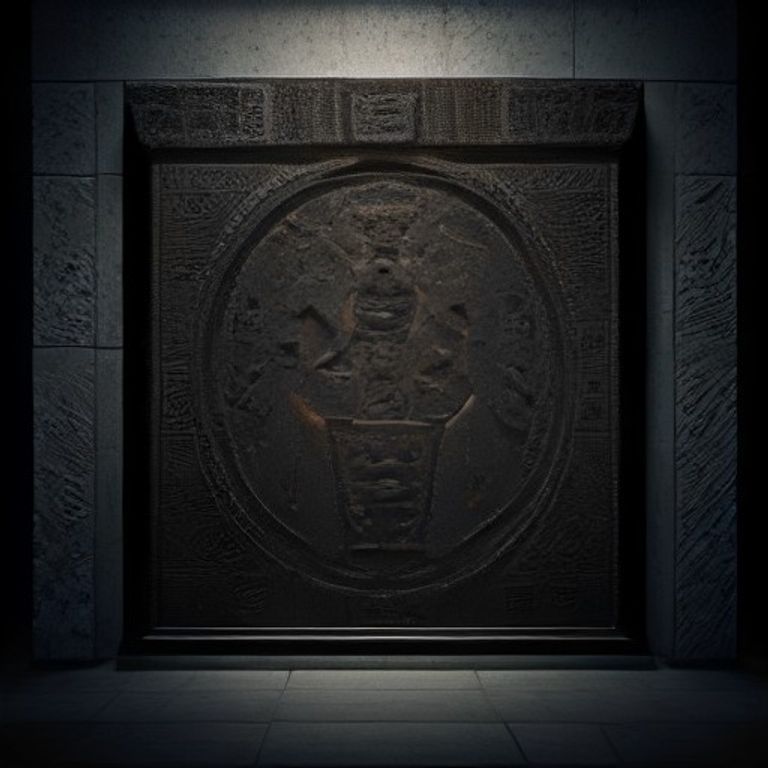
Deep within the subterranean crypts of the Temple of Hathor at Dendera, a specific relief carved into the stone has become a focal point for interpretations far removed from its original context. Known colloquially as the ‘Dendera Light,’ this scene, depicting a serpent emerging from a lotus flower, supported by a Djed pillar, is frequently presented in popular discourse as evidence of advanced ancient Egyptian technology, specifically an electric light bulb. However, a rigorous examination of the archaeological records, early excavation reports, and established Egyptological studies reveals a different narrative, one rooted deeply in the complex religious symbolism and cosmology of ancient Egypt.
This article aims to dissect the historical documentation surrounding the Dendera relief. By drawing on the meticulous records of its discoverers and subsequent authoritative Egyptological analyses, we will reconstruct the context and meaning of this celebrated scene. The objective is to clarify what the historical and scholarly records actually state about the relief, contrasting this with the interpretations that extrapolate beyond documented evidence to suggest a technological purpose.
Discovery and Early Documentation: Auguste Mariette’s Records
The Temple of Hathor at Dendera, one of the best-preserved temples in Egypt, was systematically excavated and documented by the pioneering French Egyptologist Auguste Mariette in the mid-19th century. Mariette’s comprehensive multi-volume publication, ‘Dendérah: Description générale du grand temple de cette ville’ (Librairie A. Franck, 1870-1875), provided the foundational study for understanding the temple’s architecture, inscriptions, and iconography. These volumes contain detailed plates and descriptions of every accessible part of the temple, including the eleven crypts located beneath the main structure, where the now-famous relief resides.
Mariette’s work meticulously recorded the physical appearance of the relief: its location in the lowest crypt, its dimensions, and the figures it contains. He described the Djed pillar, the large ‘bulb-like’ enclosure, the serpent within, and the figures supporting it and performing rituals around it. Crucially, Mariette’s extensive documentation, compiled through direct observation and measurement, presented these scenes solely within the framework of ancient Egyptian religious and mythological expression. His analyses focused on identifying deities, translating hieroglyphic texts, and understanding ritual practices. What his records unequivocally show is a scene consistent with the established artistic and theological conventions of the period.
What Mariette’s exhaustive studies do not say, however, is equally important. There is no mention in his detailed descriptions, nor in his subsequent interpretations of the Dendera iconography, of any anomaly or technological implication for these reliefs. His scholarly perspective, grounded in the nascent field of Egyptology, interpreted every element through the lens of religious symbolism, ritual function, and mythological narrative. The idea of the relief representing an electrical apparatus or any form of ancient technology was entirely absent from his comprehensive scientific account, indicating that no physical or textual evidence at the time suggested such a revolutionary reinterpretation.
Decoding the Iconography: The Djed Pillar and Lotus Motif
To understand the Dendera relief, it is essential to appreciate the rich symbolic language of ancient Egyptian art and religion. The elements within the relief – the Djed pillar, the lotus flower, and the serpent – are not isolated motifs but deeply embedded symbols with well-documented meanings in Egyptian cosmology. The Djed pillar, for instance, is one of the oldest and most pervasive symbols in Egyptian art, representing stability, duration, and the backbone of Osiris. Its presence typically signifies endurance and divine presence. The lotus flower, emerging from water, is a powerful symbol of creation, rebirth, and the sun’s daily resurrection from the primeval waters of Nun.
Miriam Lichtheim’s monumental work, ‘Ancient Egyptian Literature, Vol. 3: The Late Period’ (University of California Press, 1980), provides invaluable context for the religious texts that informed the iconography of temples like Dendera. While not directly translating the crypt texts, Lichtheim’s translations of hymns, rituals, and mythological narratives from the Late Period illuminate the theological landscape of the era. These texts frequently describe deities emerging from primeval chaos or primordial elements, often associated with the lotus or the Djed pillar. The serpent, in turn, is a multifaceted symbol in Egyptian religion, capable of representing both destructive and creative forces, often associated with chthonic deities, primeval gods, or the renewal of life. In the context of creation, a serpent emerging from a lotus can symbolize the manifestation of a god from the primeval waters, a powerful act of genesis.
The traditional Egyptological interpretation posits that the scene represents the birth of a deity, often identified as Harsomtus, the ‘uniter of the Two Lands,’ who is a form of Horus and son of Hathor, or another solar deity, from a celestial lotus, supported by the Djed pillar. This act of divine birth and renewal is fundamentally tied to the temple’s overall purpose as a center for the cult of Hathor and a site for celebrating cosmic regeneration. The figures around the central motif are typically priests or deities engaged in supporting the divine birth or performing accompanying rituals. Lichtheim’s work helps illustrate the breadth of such symbolic narratives prevalent in Egyptian thought, providing a textual basis for interpreting these visual representations.
The Dendera Relief in Context: Creation Myths and Temple Rituals
The Temple of Hathor at Dendera is renowned for its rich and well-preserved iconographic program, which covers virtually every surface with images and inscriptions detailing Egyptian mythology, cosmology, and ritual. The crypts, in particular, served as repositories for cult images and sacred objects, and their decorations often depict aspects of creation, rebirth, and the temple’s foundational myths. Sylvie Cauville, a leading scholar of Dendera, extensively documented these aspects in works such as ‘Le temple de Dendera: Guide archéologique’ (IFAO, 1990) and numerous specialized monographs on the temple’s inscriptions and reliefs. Her work, based on decades of fieldwork and philological analysis, offers the most authoritative Egyptological interpretation of the temple’s religious content.
Cauville’s research unequivocally places the ‘Dendera Light’ relief within the context of the temple’s overall theological program, particularly emphasizing the ‘Creation Myth of Dendera’ and the daily rituals performed to sustain cosmic order. The crypt reliefs, including this specific scene, are interpreted as part of a complex narrative cycle related to the divine birth and resurrection of the sun god and the rejuvenation of the cosmos. The ‘bulb’ is understood as a depiction of the primeval mound or the womb of the sky goddess Nut, from which the sun or a creative deity emerges, encapsulated within a lotus. The serpent within symbolizes the deity itself, often Shu, the god of air and light, or another creative force, emerging into existence.
The Djed pillar, as discussed, provides stability to this act of creation, while the figures supporting the ‘bulb’ are understood as genii or priests participating in the ritual upholding cosmic harmony. Cauville’s meticulous analysis of the accompanying hieroglyphic texts surrounding these reliefs reinforces this interpretation. These texts typically describe the divine essence, the act of creation, and the ritualistic protection of the temple’s sacred objects. What Cauville’s extensive scholarly work makes clear is that every element, from the largest figure to the smallest hieroglyph, serves a specific symbolic and religious function, consistent with Egyptian theology, and entirely devoid of any technological implication. Her work provides a comprehensive framework for understanding the relief as a sophisticated representation of sacred birth and renewal, not as a diagram of a device.
The Modern Reinterpretation: Allegations of Ancient Technology
In stark contrast to the documented Egyptological understanding, a popular modern reinterpretation suggests that the Dendera relief depicts an ancient electrical device, specifically a Crookes tube or a light bulb. Proponents of this ‘ancient advanced technology’ theory often point to superficial visual similarities between the relief’s ‘bulb-like’ shape and modern electrical apparatus. They argue that the serpent inside represents a filament, the Djed pillar a power source or insulator, and the supporting figures are operating the device. This theory is frequently advanced without reference to the extensive textual and iconographic evidence from ancient Egypt itself.
The claims typically involve assertions that ancient Egyptians possessed knowledge of electricity, which they used to illuminate the dark chambers of their temples. However, no archaeological evidence—such as wires, generators, batteries, insulated components, or written instructions for electrical devices—has ever been found in Egypt or any other ancient civilization. The consistent method for lighting interior spaces in ancient Egyptian temples and tombs was through the use of oil lamps, torches, and sunlight directed by polished copper mirrors, evidence for which is abundant and well-documented. For instance, soot marks are found on the ceilings of many ancient structures, but notably absent from the crypts of Dendera, which is sometimes presented as ‘proof’ of non-soot-producing light. However, the precise ventilation systems of the crypts, the type of lamps used, and the careful cleaning practices of the priests could account for the lack of soot, without invoking electricity.
Popular retellings of the ‘Dendera Light’ often stretch the visual evidence by cherry-picking elements that superficially resemble modern technology while ignoring the overwhelming context of Egyptian religious art. They disregard the millennia of artistic conventions, symbolic meanings, and theological narratives that Egyptologists have meticulously pieced together from countless sources. The Djed pillar’s well-established meaning as stability, for example, is reinterpreted as an ‘insulator’ or ‘power generator’ without any textual or archaeological basis for such a function in an ancient Egyptian context. The serpent’s religious significance is similarly dismissed in favor of a ‘filament’ analogy. This approach fundamentally disconnects the artifact from its cultural and historical milieu, imposing a modern technological framework onto an ancient symbolic representation.
Art, Symbolism, and the Limits of Evidence
The persistent fascination with the ‘Dendera Light’ as an alleged ancient technology highlights a broader tendency to interpret ancient artifacts through a modern lens, often bypassing rigorous scholarly methods. The documentary evidence, spanning from Auguste Mariette’s foundational excavations to the detailed philological and iconographic analyses of scholars like Miriam Lichtheim and Sylvie Cauville, consistently points to a sophisticated religious and mythological interpretation of the relief. These scholars have painstakingly reconstructed the symbolic language, theological narratives, and ritual practices that defined ancient Egyptian culture, providing a robust framework for understanding such intricate artistic expressions.
The Djed pillar, the lotus, and the serpent are not isolated visual elements but integral components of a complex system of beliefs regarding creation, regeneration, and cosmic order. The Dendera relief, in its original context, communicated profound theological truths to the ancient Egyptians, truths that were visually reinforced throughout the temple’s design. To interpret it as a technological diagram requires a systematic rejection of virtually all available historical, textual, and archaeological evidence for ancient Egyptian science and religion. It also necessitates inventing a vast, undocumented history of technological prowess for which there is no material proof.
The value of documentary evidence lies in its ability to anchor our interpretations in the past’s own terms, rather than projecting our present-day assumptions onto it. The records of Mariette provide the initial, unbiased physical description. The works of Lichtheim and Cauville offer the deep contextual understanding derived from decades of dedicated scholarship. Together, they demonstrate that the ‘Dendera Light’ is not a mysterious technological relic, but a powerful and eloquent testament to the ancient Egyptians’ rich symbolic imagination and their profound engagement with the mysteries of creation and divine life.
Researching declassified archives and deciphering ancient secrets requires a lot of time and resources. If you like these stories from the cradle of civilization, support the digital scribe in his further work and buy him a coffee.
Enjoyed this topic? Explore these recommended books for further reading.
Agartha: The Earth's Inner World
Ancient Egipt: Magicians of the Gods
Atlantis: Atlantis and the Ten Plagues of Egypt: The Secret History Hidden in the Valley of the Kings
Lemuria: The Lost Civilization of Lemuria: The Rise and Fall of the World's Oldest Culture
Sumer: The Sumerians: A History From Beginning to End (Mesopotamia History)
Tartaria: The One World Tartarians (Black and White): The Greatest Civilization Ever Erased From History
As an Amazon Associate I earn from qualifying purchases at no extra cost to you. Thank you for your support!