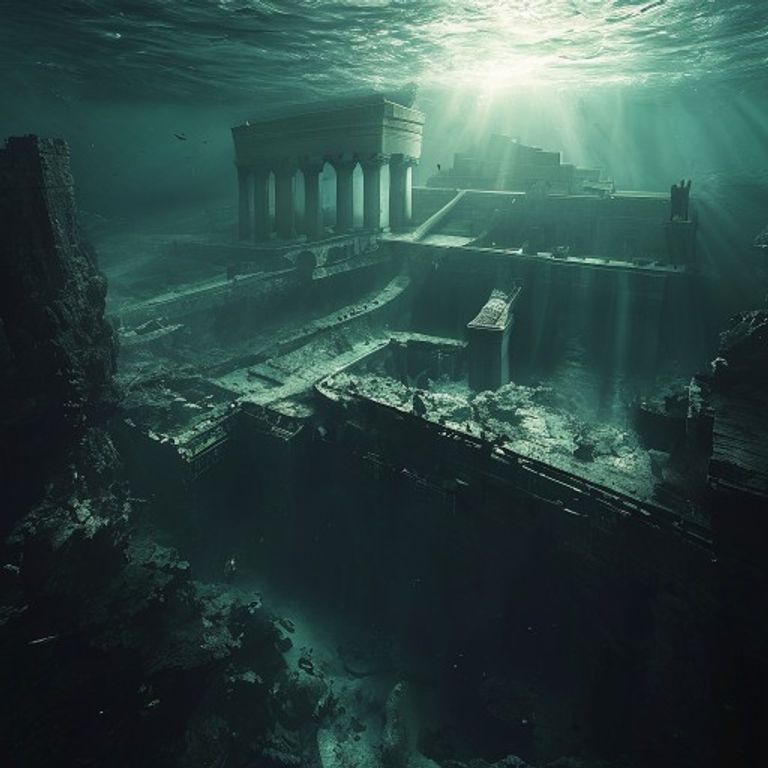
Plato Tells You Exactly Where He Got It
Almost every claim ever made about Atlantis rests on two dialogues written by one man around 360 BC. There is no earlier Greek source. No Homeric reference, no Herodotean aside, no inscription. Plato’s Timaeus and Critias are the whole of it, and everything since is commentary on a text anyone can read in an afternoon.
What makes those dialogues interesting is not the island. It is that Plato supplies a chain of custody for the story and does not pretend otherwise.
In his telling, the account came from priests at Sais in Egypt, who told it to the Athenian statesman Solon. Solon passed it to his relative Dropides. Dropides told his son Critias. That Critias, in old age, told it to his grandson, who was a boy at the time and who repeats it in the dialogue from memory decades later. The events themselves are placed nine thousand years before Solon, on an island beyond the Pillars of Heracles, larger than Libya and Asia combined.
So the source is a fourth-hand recollection of a childhood memory of an old man’s account of what foreign priests had said about events nine millennia earlier. Plato writes that down himself. He is not hiding the weakness of the chain; he is constructing it in plain view, in a dialogue whose explicit subject is an ideal state and its corruption.
That framing is the first thing any reader can check, and it costs nothing. The dialogues are in the public domain in a dozen translations. Anyone who tells you what Plato said about Atlantis is making a claim you can verify in twenty minutes, which is more than can be said for most of what follows.
A Prediction With Two Dates
Between Plato and the modern legend lies a gap of more than two thousand years in which almost nobody thought about Atlantis at all. What closed it was a single book. In 1882 Ignatius Donnelly, a former United States congressman from Minnesota, published Atlantis: The Antediluvian World, which argued that a real Atlantic continent had been the source of every ancient civilisation from Egypt to Peru, and that the parallels between them — pyramids, flood myths, sun worship — proved a common origin. The book sold enormously and went through dozens of printings. Practically every twentieth-century Atlantis claim, including the ones that followed, descends from it rather than from Plato. It is worth knowing that the modern story has an author and a publication date.
The modern Atlantis story then pivots on something more specific, and genuinely remarkable.
Edgar Cayce, an American who delivered thousands of trance readings between 1901 and 1944, addressed Atlantis repeatedly. On 20 December 1933, in reading 440-5, he stated that a portion of the Atlantean temples might yet be found beneath the sea near Bimini, off the coast of Florida. Seven years later, on 28 June 1940, reading 958-3 went further. It said that Poseidia would be among the first portions of Atlantis to rise again, and it attached a date: expect it in sixty-eight and sixty-nine
.
In September 1968, Dr J. Manson Valentine — a zoologist and honorary curator at the Museum of Science in Miami — was diving off North Bimini when he found a linear formation of large, roughly rectangular limestone blocks lying in around eighteen feet of clear water. It ran for roughly half a mile in a northeast-to-southwest line, with a distinct hook at one end. It looked, to the divers who first saw it, like a paved road.
It became known as the Bimini Road.
What is documented
Both dates. The readings are archived and numbered, and the discovery is recorded in the diving and museum literature of the period. A specific location was named in 1933, a specific pair of years was named in 1940, and something structurally suggestive was found at that location in the first of those years. Nobody serious disputes this sequence, and the honest response to it is not dismissal.
What is not documented
That what Valentine found is what the reading described. The 1940 reading speaks of land rising; the Bimini Road did not rise, and has not risen. It was found by looking down. Nor does the sequence tell you anything about the formation’s origin, which is a separate question with its own evidence — and that evidence arrived nine years later, in the form of a coring drill.
What the Cores Showed
Eugene A. Shinn, a geologist with the United States Geological Survey, began diving the site in the mid-1970s with a newly developed diver-operated coring device. In 1977 he extracted core samples from the blocks themselves. The following year, the radiocarbon laboratory in the Department of Geology at the University of Miami dated them, and in 1979 Calvert and colleagues published the results.
The numbers are specific and worth stating rather than summarising. Whole-rock samples returned dates of 2,780 ± 70, 3,500 ± 80 and 3,350 ± 90 radiocarbon years before present. Shells extracted from the core dated to 3,510 ± 70. The carbonate cement binding those shells together dated to 2,770 ± 80 and 2,840 ± 70.
Those figures are internally consistent in exactly the way a natural process predicts: the shells are older than the cement that later locked them into rock. The formation is beachrock — sand, shell fragments and coral debris cemented together by carbonate-rich seawater in the intertidal zone, then submerged as sea level rose, then cracked along natural joints by wave action into blocky slabs.
Petrographic work supported the same reading. John A. Gifford and Mahlon M. Ball published their survey of the submerged beachrock deposits in the National Geographic Society Research Reports in 1980. Thin sections showed layering, embedded shell fragments and foraminifera running consistently through the blocks — the internal signature of sediment cemented in place, not of stone quarried and moved. Shinn published his own account under the title Atlantis: Bimini’s Hoax in Sea Frontiers in 1978, and with the archaeologist Marshall McKusick took the argument to Nature in volume 287, on 4 September 1980.
What the cores establish
That the rock formed naturally, roughly three thousand years ago, from local intertidal sediment. No tool marks. No mortar. No non-local material. No artefacts, wheel ruts or occupation debris anywhere on the site. And a date roughly eight thousand years short of Plato’s figure.
Why the Cores Do Not Close It
Here is where most accounts stop, and where the honest version keeps going.
A radiocarbon date on beachrock tells you when the rock formed. It does not, by itself, tell you when the blocks came to sit in the arrangement they now occupy. If a formation of naturally cemented slabs were later moved, or if slabs were quarried from a natural beachrock pavement and repositioned, the cores would return the age of the rock either way. That objection is logically sound, and it is the one the sceptical literature answers least directly.
Several researchers pressed it. David Zink published The Stones of Atlantis in 1978. The Russian-born oceanographer Dimitri Rebikoff surveyed the area and reported additional features. William Donato submitted a master’s thesis re-examining the Atlantis theory in 1979 and argued for years afterwards that specific features at the site — smaller stones apparently wedged beneath larger ones, in the manner of props — are difficult to produce by wave action alone.
The geometry itself is the strongest part of their case. Beachrock is common throughout the Bahamas and the Caribbean, and it does crack into rectangular slabs. What is less common is a continuous half-mile linear arrangement with parallel elements and a pronounced hook. Shinn’s answer — that tidal cycles, wave agitation and differential settling produce exactly this pattern, which he tested against comparable formations — is a good answer. It is not a knock-down one, and the people who find it insufficient are not all cranks.
What can be said with confidence is asymmetric. The natural explanation accounts for the composition, the internal structure, the dating and the absence of any associated material culture. The artificial explanation accounts for the geometry and nothing else. That is not a tie, but it is also not silence.
The Detail That Rarely Survives the Retelling
Any account of the 1968 discovery that leaves out the following is incomplete, and most do.
The researcher Andrew Collins has pointed out that Cayce had business dealings with men who held property on Bimini before he gave the Atlantis readings, and that they had brought him to the island in the hope that he could locate buried Spanish treasure by psychic means. That is not a claim of fraud, and it should not be presented as one. What it establishes is narrower and more useful: Bimini was already a place Cayce had reason to be thinking about when he named it.
The same caution applies in the other direction. Cayce’s grandson and biographers noted that his readings on Atlantean technology track closely with themes available in print at the time, including Francis Bacon’s New Atlantis, which raises the ordinary question of prior exposure rather than the extraordinary one. And the 1940 reading contains other datable predictions for the same period which did not occur.
None of this settles what Valentine found. It does mean that the sequence — named location, named years, discovery — is less unlikely than it appears when the location is named by someone who had already been there on business, and when the date lands in a decade of intense diving activity in exactly that spot, conducted largely by people looking for the thing the reading described. Cayce’s foundation had researchers in the water. Finding something in shallow Bahamian limestone was not a remote outcome. This is the same pattern that runs through the Hall of Records surveys at Giza, where believers, sceptics and the same clairvoyant’s readings all converge on one site and the drilling finds natural cavities.
The Answer That Needed No Psychic, and How to Check Any of It
There is an older explanation for Atlantis that has been sitting in the academic literature for over a century, and it is startlingly little known.
In 1909 an anonymous letter appeared in The Times under the heading of a lost continent, arguing that the palaces newly excavated at Knossos showed the Atlantis story to be Mediterranean in origin, and that the Minoans were the Atlanteans. The author turned out to be the historian K. T. Frost, who expanded the case in the Journal of Hellenic Studies in 1913. In 1939 the Greek archaeologist Spyridon Marinatos published The Volcanic Destruction of Minoan Crete in Antiquity, volume 13, arguing that the eruption of Thera had ended the Minoan world — and the journal’s editors forbade him from mentioning Atlantis in it. He made the connection explicitly only later. In the 1960s Angelos Galanopoulos added the proposal that the story’s impossible numbers came from a factor-of-ten error in transmission, which turns nine thousand years into nine hundred and lands the whole account squarely in the Bronze Age.
The objections are real and should be stated too: Thera is in the Aegean, not beyond the Pillars of Heracles; Crete did not sink; and the sea where Plato’s island vanished is described as impassable with shoals, which the Aegean has never been. The Minoan hypothesis is a hypothesis, not a conclusion.
What is not in doubt is that a plausible historical kernel, a documented catastrophe and a century of published scholarship all exist for this question, and that none of it requires a single classified file. Which is the point worth ending on. Everything cited in this article can be checked without permission from anyone: Plato’s dialogues in any public-domain translation; the Cayce readings by their numbers, 440-5 and 958-3, in the archive his foundation maintains; the radiocarbon results in Calvert and colleagues, 1979; Gifford and Ball in the National Geographic Society Research Reports for 1980; Shinn and McKusick in Nature 287, dated 4 September 1980; Marinatos in Antiquity 13, 1939.
Six citations, six things you can hold in your hand and disagree with. Claims about Atlantis that come attached to file numbers from agencies which will neither confirm nor produce them are asking for something different, and the difference is worth learning to spot. The geological side of the question — whether an ocean can swallow a continent at all — is treated separately in our piece on plate tectonics and a sunken Atlantis.
The ocean is vast and largely unmapped, and that fact deserves its due weight rather than a rhetorical flourish. But the half-mile of stone off North Bimini has been cored, sectioned, dated and published. Whatever else remains hidden down there, this particular thing has been looked at closely by people who wrote down what they found.
Researching declassified archives and deciphering ancient secrets requires a lot of time and resources. If you like these stories from the cradle of civilization, support the digital scribe in his further work and buy him a coffee.
Enjoyed this topic? Explore these recommended books for further reading.
Agartha: The Earth's Inner World
Ancient Egipt: Magicians of the Gods
Atlantis: Atlantis and the Ten Plagues of Egypt: The Secret History Hidden in the Valley of the Kings
Lemuria: The Lost Civilization of Lemuria: The Rise and Fall of the World's Oldest Culture
Sumer: The Sumerians: A History From Beginning to End (Mesopotamia History)
Tartaria: The One World Tartarians (Black and White): The Greatest Civilization Ever Erased From History
As an Amazon Associate I earn from qualifying purchases at no extra cost to you. Thank you for your support!