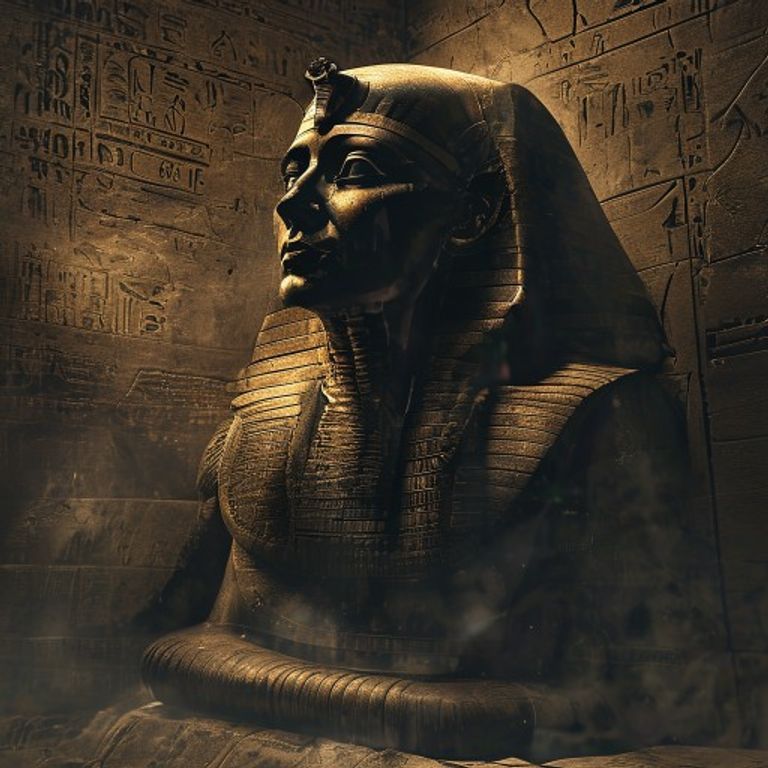
A Monument With No Builder’s Inscription
Nearly every major structure on the Giza plateau announces who made it. Quarry marks, dedicatory inscriptions, the names of work gangs daubed on blocks, the tombs of the officials who oversaw the projects — the Fourth Dynasty was administratively noisy, and it left paperwork in stone.
The Great Sphinx left none.
No Old Kingdom text names its builder. No inscription appears on the monument itself, which is unsurprising given that it has no flat surfaces suited to one and no interior chambers at all. The entire textual basis for attributing it to any particular king rests on a single object, and that object is damaged.
The Dream Stele is a granite slab roughly 3.6 metres tall, erected between the Sphinx’s paws by Thutmose IV in the first year of his reign, around 1401 BCE — some eleven centuries after the Fourth Dynasty. It was rediscovered in 1818 during Giovanni Battista Caviglia’s clearance of the monument. It is itself a reused door lintel, taken from the entrance to Khafre’s mortuary temple; the pivot sockets on its reverse match the threshold there. Roughly half of its text is now lost to a crack that begins at the twelfth line.
The stele records a dream: the young prince, resting in the Sphinx’s shadow, is promised the throne if he will clear the sand burying the monument. Somewhere in the damaged portion appears a syllable that has been read as part of Khafre’s name. That reading is the connection. Mark Lehner, who has spent more of his working life on this monument than almost anyone, has described that connection as problematic even while defending the Fourth Dynasty date on other grounds.
This matters because it defines the shape of the argument. Almost everything anyone claims about when the Sphinx was carved is an inference drawn from stone, sequence and weathering — not from a text. That is exactly the condition under which a serious dispute can persist for decades without resolving.
1991: A Geologist at the Enclosure Wall
The observation is older than the controversy. R.A. Schwaller de Lubicz, a French esotericist working in Egypt, noted in the 1950s that the walls surrounding the Sphinx looked to him as though water had shaped them. The idea sat largely dormant until the author John Anthony West took it up and, around 1989, sought a professional opinion from Robert M. Schoch, a geologist at Boston University with a Yale doctorate in geology and geophysics.
Schoch’s assessment was that the enclosure walls show deep, rounded, vertically undulating fissuring — the profile produced by prolonged rainfall running down a limestone face, widening pre-existing joints from the top. He contrasted this with the horizontal, layered scouring that wind-driven sand produces, which he identified on other Giza structures conventionally dated to the Old Kingdom. He also documented a gradient: the weathering is heaviest at the western end of the enclosure and tapers markedly towards the east.
In April 1991, West and Schoch brought the Houston geophysicist Thomas Dobecki to Giza to test the idea from below. Working with permission from the Egyptian Antiquities Organization, Dobecki generated seismic waves by striking a steel plate with a sledgehammer and measured how they returned from the bedrock, which reveals how deeply the subsurface limestone has been altered by weathering. The survey indicated weathering to a depth of roughly six to eight feet along the front and sides of the enclosure, and roughly half that behind the monument.
Schoch’s interpretation was that the rear of the enclosure was cut later — in the Old Kingdom, as conventionally assumed — while the front and sides had been exposed for roughly twice as long. On 23 October 1991, he and West presented the case at the Geological Society of America’s annual meeting in San Diego.
What the survey established
That the enclosure walls weather unevenly, that the western end is worse, and that subsurface alteration is deeper at the front than the rear. These are measurements, and they have not been seriously contested.
What it did not establish
A date. Weathering depth converts to elapsed time only if you assume a weathering rate, and the rate depends on which mechanism you think is operating. Schoch’s figures — initially a range around 10,000 to 5,000 BCE, later narrowed to a minimum of roughly 5000 BCE for the core body — follow from assuming rainfall is the dominant agent. That assumption is precisely what the counter-arguments attack.
The Counter-Arguments, at Full Strength
The response was not dismissal. It was a set of competing mechanisms, each proposed by a working geologist, each capable in principle of producing deep weathering inside four and a half thousand years.
K. Lal Gauri of the University of Louisville had studied the Sphinx for roughly a decade before the controversy began. With John J. Sinai and Jayanta K. Bandyopadhyay, he published a direct response in Geoarchaeology in April 1995, arguing that salt exfoliation — haloclasty — driven by nightly atmospheric condensation and evaporation was sufficient to account for the monument’s condition within the last 4,500 years. Salts dissolved in moisture migrate into the porous limestone, crystallise as it dries, and prise the rock apart from within. Gauri had earlier favoured upward seepage of groundwater and revised his position after watching how quickly exposed blocks deteriorated.
James A. Harrell of the University of Toledo argued a different mechanism in the pages of KMT across 1992 and 1994, in a genuinely useful published exchange with Schoch. Harrell noted that for most of its history the Sphinx has been buried in wind-blown sand. That sand is porous and permeable: it absorbs rainfall and Nile flood water and holds the buried limestone wet for weeks or months at a time. Chemical weathering under a wet sand blanket, on his account, does what Schoch attributes to direct rainfall — without requiring a wetter climate.
Harrell also made a point that is easy to underrate. The exposed limestone at Giza spalls at an alarming rate today. A century of that behaviour would leave an originally smooth monument deeply weathered. On his reading, most of the damage could have accumulated in the roughly eleven hundred years between Khafre’s reign and Thutmose IV’s restoration — a window that fits the conventional date without strain.
Peter Lacovara, an Egyptologist and museum curator, added a third consideration: some of what is read as weathering on the enclosure walls is quarrying damage, left by the workers who cut the blocks out, never smoothed because these were working faces rather than finished surfaces.
None of these has been unified into a single complete account, and their proponents do not entirely agree with one another. That is an honest description of the state of the geology, and it cuts both ways: the conventional side has several partial explanations rather than one decisive one.
The Archaeological Sequence
The strongest case for the Fourth Dynasty date is not geological at all. It is a matter of what was cut before what.
The Sphinx Temple, immediately in front of the monument, is built from limestone blocks quarried out of the Sphinx enclosure itself. The statue and the temple are therefore products of a single operation: you cannot have the temple without having excavated the enclosure to get its stone. Khafre’s causeway, which links his pyramid to the Valley Temple, does not run along the cardinal directions but at a slant — and the southern wall of the Sphinx enclosure respects that same slant. A drainage channel associated with the causeway terminates where the Sphinx would later be cut, implying that the ground was still intact when the causeway was laid out.
A diorite statue of Khafre was recovered from the Valley Temple, buried upside down among debris. Luminescence dating of the two temples has returned dates in the middle to late third millennium BCE, consistent with the Fourth Dynasty and with radiocarbon results from the Giza pyramids. During the 1990s, Zahi Hawass and Mark Lehner excavated a workers’ cemetery and an associated settlement to the southwest, dated by pottery and inscription to the middle of the Fourth Dynasty — the administrative apparatus that a project of this scale requires, sitting exactly where and when it should.
Lehner and the sculptor Rick Brown also tested the labour question directly, carving a scaled version of the Sphinx’s nose with replica copper and stone tools. Their extrapolation: about a hundred people working for three years. The monument does not require unknown technology, which is a separate question from when it was made, and one worth keeping separate. The same applies to the tool marks on Egypt’s hard-stone work, which are documented and experimentally reproduced, and to the megalithic construction record more broadly.
Against Schoch’s dating, Lehner has pressed the question his colleagues consider decisive: where is the civilisation? A monument on this scale implies quarrying, surveying, food supply, labour organisation and record-keeping. Egypt in the seventh millennium BCE has left no trace of any of it. An older Sphinx requires an entire missing society, and absence of that society is a heavier problem than any single weathering profile.
The Middle Position Almost Nobody Quotes
The public argument is usually staged as Ice Age versus Fourth Dynasty, which is convenient for both sides and obscures the most interesting work done on the question.
Colin Reader, a British engineering geologist, accepted that the enclosure shows genuine rainfall weathering and rejected the enormous antiquity that Schoch drew from it. His proposal is that the Sphinx dates to the Early Dynastic Period — earlier than Khafre, but centuries rather than millennia, and comfortably inside recorded Egyptian history.
His arguments are specific and testable. Tombs cut into the western enclosure wall in the 26th Dynasty, around 600 BCE, still carry visible tool marks. If generalised salt weathering or wet sand explained the condition of those walls, marks that old should not have survived on the same surface. The Sphinx’s chest is carved from the same limestone band as the western wall and faces east into the same sun, yet it lacks the deep fissuring that wall displays. And the quarries north of the Khafre causeway appear to have been worked by Khufu’s people in a way that deliberately spared the ridge the causeway now occupies — which makes better sense if that line already served as a path to something standing there.
Reader placed the Sphinx, the Sphinx Temple and a proto-mortuary temple, all facing the sunrise, as a local solar cult site predating Giza’s use as a necropolis. Early Dynastic material found near Giza by the archaeologist Karl Kromer indicates people were in the area at the relevant time. His position has its own critics — the sheet-wash mechanism he relies on tends to form channels rather than flow evenly across a face — but it demonstrates something the popular framing hides: accepting the rainfall evidence does not commit anyone to a lost civilisation.
What Would Actually Settle It
Underneath all of this sits a claim that predates the geology entirely. In readings given in the 1930s, the American clairvoyant Edgar Cayce described refugees from Atlantis depositing a record of their knowledge at Giza, near the Sphinx. When Dobecki’s 1991 survey reported subsurface anomalies including an apparent void near the front paws, the two stories fused, and they have been fused in popular treatments ever since.
The anomalies were investigated. Remote sensing at Giza goes back at least to the 1977 SRI International work by Lambert Dolphin, Ahmed Moussa and colleagues, and ground-penetrating radar surveys and drilling followed in the 1990s. What the boreholes encountered were natural cavities and fissures in the limestone, along with man-made shafts and tunnels belonging to the necropolis’s long history of reuse. No chamber matching Cayce’s description has been located.
There is an irony here worth stating plainly. Mark Lehner — now the most prominent defender of the Fourth Dynasty date — first went to Egypt with support from Cayce’s own foundation and published a book through its press in 1974. He went looking for the Hall of Records, spent decades mapping the plateau instead, and changed his mind on the evidence. Whatever else the Giza literature lacks, it is not an example of someone following the data away from a belief they arrived with.
The dispute remains open because the decisive tests have not been run. Optically stimulated luminescence dating of the enclosure walls could establish when those surfaces were last exposed to sunlight, which is the actual question. Modern geophysical survey with current instruments would supersede a seismic profile taken in 1991. Excavation of the anomalies that survey detected would replace inference with observation. The paleoclimate record for the eastern Sahara — the African Humid Period and the contested timing of its end — bears directly on whether sufficient rainfall was available late enough to matter, and that record has improved considerably since the argument began.
None of this requires hidden files or suppressed reports. The claim that such documents exist and are being withheld is checkable against the actual declassified archives, and it does not survive the check. The Sphinx argument is conducted in journals, at conferences and in print, by named people who disagree in public and publish their reasoning. It is unresolved for the ordinary reason that arguments go unresolved: the measurement that would decide it has not yet been made.
Researching declassified archives and deciphering ancient secrets requires a lot of time and resources. If you like these stories from the cradle of civilization, support the digital scribe in his further work and buy him a coffee.
Enjoyed this topic? Explore these recommended books for further reading.
Agartha: The Earth's Inner World
Ancient Egipt: Magicians of the Gods
Atlantis: Atlantis and the Ten Plagues of Egypt: The Secret History Hidden in the Valley of the Kings
Lemuria: The Lost Civilization of Lemuria: The Rise and Fall of the World's Oldest Culture
Sumer: The Sumerians: A History From Beginning to End (Mesopotamia History)
Tartaria: The One World Tartarians (Black and White): The Greatest Civilization Ever Erased From History
As an Amazon Associate I earn from qualifying purchases at no extra cost to you. Thank you for your support!