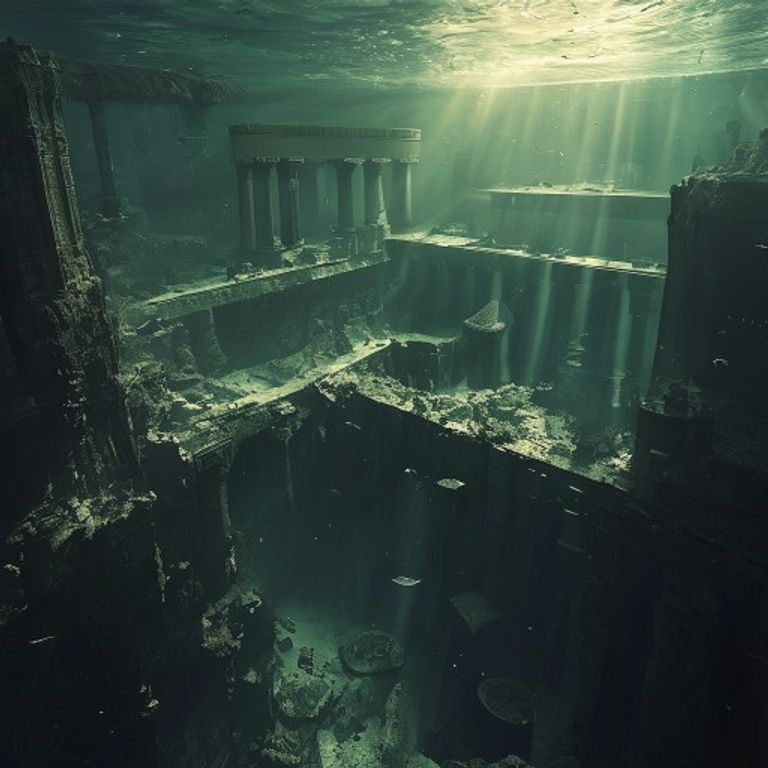
Unraveling Mythic Origins: Beyond Plato’s Sunken Realm
The quest for Atlantis, as described by Plato, often conjures images of deep-sea expeditions and hidden continental fragments. Yet, a different, arguably more fruitful line of inquiry has emerged: not whether Atlantis existed precisely as Plato described, but whether his compelling narrative drew inspiration from genuine historical events or advanced civilizations. This approach shifts our focus from proving a myth’s literal truth to understanding its potential roots in the observable past, utilizing the tools of archaeology, geology, and historical linguistics. Rather than chasing a phantom island, we examine the echoes of real-world phenomena that could have shaped Plato’s philosophical tale. It is a critical distinction, acknowledging Plato’s use of allegory while still probing for empirical antecedents.
For centuries, scholars have grappled with the question of whether Plato simply invented Atlantis as a narrative device or if he was transmitting, albeit through layers of time and interpretation, a memory of a cataclysmic event or a powerful lost culture. Plato himself attributes the story to Egyptian priests and Solon, suggesting an ancient lineage. This perspective encourages us to consider how oral traditions, fragmented historical accounts, and even geological upheavals might have percolated through Hellenic society, eventually finding expression in his dialogues. The challenge lies in sifting through the narrative embellishments to identify any credible historical or archaeological parallels, always with a careful eye on the inherent limitations of such comparative analysis.
My interest lies not in asserting a definitive ‘Atlantis found’ claim, but in exploring the rich tapestry of potential real-world influences. This intellectual journey demands a rigorous examination of the evidence, acknowledging both striking similarities and significant discrepancies between the Platonic account and archaeological discoveries. We must ask: what aspects of ancient Mediterranean civilizations and their environmental histories might have provided the raw material for such a vivid and enduring legend? The search becomes less about pinpointing an exact location and more about understanding the complex interplay between human culture, natural disaster, and the creation of myth.
The Aegean Hypothesis: Minoans and the Fury of Thera
Among the most compelling candidates for a real-world inspiration for Atlantis is the Minoan civilization, centered on Crete, and the catastrophic eruption of the Thera volcano (modern Santorini) around 1600 BCE. The Minoans were a highly sophisticated Bronze Age society, flourishing in the Aegean from approximately 2700 to 1450 BCE. Their culture was characterized by monumental palatial complexes like Knossos, advanced craftsmanship, a unique writing system (Linear A), and, crucially, formidable maritime power. Their ships dominated the Aegean, facilitating extensive trade networks across the Mediterranean. This civilization, rich in art and architecture, represents a high point of Bronze Age ingenuity, a society whose complexity and apparent peaceful nature often draw parallels with Plato’s descriptions of early Atlantean prosperity.
The island of Thera, located north of Crete, was home to Akrotiri, a thriving Minoan outpost. This settlement was exceptionally well-preserved by volcanic ash, akin to Pompeii, offering an invaluable snapshot of Minoan urban life. The city boasted multi-story buildings, sophisticated drainage systems, and exquisite frescoes, all indicative of a prosperous and technologically advanced society. However, around 1600 BCE (dates vary slightly by scholars, typically ranging from 1620 to 1600 BCE), Thera underwent one of the most powerful volcanic eruptions in recorded history, a cataclysm now known as the Minoan eruption. This event dwarfed the 1883 Krakatoa eruption in scale, blasting vast quantities of ash and pumice into the atmosphere and fundamentally reshaping the island, turning its single volcanic cone into the caldera we see today.
The impact of the Thera eruption was far-reaching. Tsunamis, estimated to be dozens of meters high, devastated coastal settlements across the Aegean, including many on Crete itself. Ashfall would have disrupted agriculture and climate across the eastern Mediterranean for years. While the Minoan civilization on Crete did not vanish overnight, the eruption delivered a severe blow, weakening its infrastructure and economy, making it vulnerable to subsequent Mycenaean incursions. The memory of such a cataclysm, combining an advanced island civilization with a sudden, devastating natural disaster, holds undeniable resonance with elements of Plato’s Atlantis narrative, suggesting a plausible historical antecedent for the myth of a powerful island kingdom swallowed by the sea.
Echoes in the Ash: Connecting Thera to the Atlantean Narrative
The parallels between the Minoan civilization, particularly as observed through the lens of the Thera eruption, and Plato’s account of Atlantis are compelling enough to warrant sustained academic attention. For instance, Plato describes Atlantis as a technologically advanced island nation with formidable naval power and impressive architecture, characteristics that align remarkably well with the Minoan thalassocracy. The intricate palatial complexes of Crete, with their advanced plumbing and frescoes, certainly suggest a level of sophistication comparable to what might be remembered of a ‘mythical’ great civilization. The very structure of Akrotiri, before its burial, reveals a complex, multi-layered urban planning that could easily inspire tales of an engineered city.
Furthermore, the cataclysmic destruction of Thera provides a geological mechanism strikingly similar to the demise of Atlantis. Plato states that Atlantis was ‘swallowed by the sea in a single day and night of misfortune.’ While the Minoan civilization on Crete was not instantly submerged, the eruption of Thera would have generated immense tsunamis that obliterated coastal towns and rendered large areas uninhabitable. The sheer scale of this natural disaster, leading to widespread destruction and potential climate disruption, could certainly have been remembered as an event of such magnitude that it effectively ‘swallowed’ an advanced island culture from the perspective of distant observers or later generations. This memory, passed down through oral tradition, could have morphed into the rapid and complete obliteration recounted by Plato.
One of the most intriguing connections relates to the geography and description of Atlantis. Plato details concentric rings of land and water around the capital city. While Thera is not geometrically concentric in the way Plato describes, its post-eruption caldera, with its central islands and surrounding sea, could be seen as a visual inspiration for such a layout. The island’s original pre-eruption form might have also possessed a distinct circularity from the perspective of sailors approaching its volcanic peak. The visual impact of such a unique geological feature, combined with the memory of a rich culture and a devastating end, offers a potent mix for mythological generation, making the evolving idea of Atlantis a complex interplay of reality and narrative crafting. Professor Spyridon Marinatos, a prominent Greek archaeologist, was one of the first to strongly advocate for the Thera-Atlantis connection in the mid-20th century, drawing attention to these powerful resemblances.
The Critical View: Discrepancies and the Gap in Evidence
Despite the compelling parallels, linking the Minoans and Thera directly to Plato’s Atlantis presents significant challenges and discrepancies that demand careful consideration. Perhaps the most glaring issue is the timeline. Plato explicitly places Atlantis ‘nine thousand years before the time of Solon,’ which would mean around 9600 BCE. The Thera eruption, however, occurred around 1600 BCE, a difference of roughly 8,000 years. While some proponents suggest that Solon (or the Egyptian priests) mistranslated ‘thousands of years’ for ‘hundreds of years,’ thereby reducing the gap to a more manageable 900 years, this explanation requires a substantial assumption about a specific error in transmission, for which there is no direct evidence. It remains a speculative leap, not a supported fact.
Geographical discrepancies also pose a problem. Plato clearly states Atlantis was ‘beyond the Pillars of Heracles’ (Strait of Gibraltar), placing it in the Atlantic Ocean. The Minoan civilization and Thera are firmly located in the Aegean Sea, deep within the Mediterranean. This fundamental geographical mismatch is difficult to reconcile without resorting to reinterpretations of Plato’s geography as symbolic or allegorical, or assuming a complete re-location of the story over millennia. While myths often transmute geographical details, a shift from the Atlantic to the Aegean is a considerable one. Furthermore, Plato’s detailed description of Atlantis’s political structure, its vast army, and its attempted invasion of Europe and Asia Minor find no direct counterpart in what we know of the Minoans, who appear to have been a largely peaceful, trading society, not a militaristic empire.
Moreover, the philosophical purpose of Plato’s Atlantis narrative cannot be overlooked. In his dialogues, Atlantis serves as a foil to the ideal Athenian state, a cautionary tale about the dangers of imperial ambition and moral decay. While a real-world disaster might have inspired certain elements, the specific details and the overarching moral framework of Plato’s account are likely products of his own philosophical agenda, rather than a direct historical report. To force a complete alignment between the Thera eruption and Atlantis risks overlooking Plato’s literary and philosophical intent. The story of Atlantis, as transmitted by Plato, is a composite, and while it may contain fragments of distant memories, its final form is shaped by intellectual and moral concerns, not strictly historical reporting. This distinction is crucial for understanding the echoes of Atlantis in subsequent thought.
Beyond the Aegean: Other Contenders for Atlantis’s Muse
While the Minoan/Thera hypothesis is perhaps the most widely discussed, it is not the only historical or geological phenomenon proposed as an inspiration for the Atlantis legend. One intriguing candidate is Tartessos, an ancient civilization that flourished in southwestern Iberia, near the mouth of the Guadalquivir River, around the 8th to 6th centuries BCE. Historical accounts, primarily from Greek and Roman sources, describe Tartessos as a wealthy city-state, rich in metals, with a sophisticated culture and extensive trade networks. Its eventual decline and disappearance from the historical record, potentially due to environmental changes or Punic expansion, have led some, notably the German scholar Adolf Schulten in the early 20th century, to suggest it might have been Plato’s inspiration for a powerful, lost civilization beyond the Pillars of Heracles. However, archaeological evidence for Tartessos is still fragmented, and its demise was a gradual process, not the sudden cataclysm Plato describes.
Another often-cited example is Helike, an ancient Greek city in Achaea that was submerged by an earthquake and tsunami in 373 BCE. This event was well-documented by contemporaries and fits the ‘swallowed by the sea’ narrative more closely than Thera, both in its suddenness and its geographical proximity to the Greek world. Its remains are believed to lie beneath the silt of the Gulf of Corinth. While Helike provides a direct example of a sunken city, its scale and reported power do not match Plato’s description of a vast empire, nor does its demise predate Plato’s account significantly enough to serve as a deep historical memory. It illustrates, however, the common occurrence of such coastal disasters in the active seismic zones of the Mediterranean, highlighting that the concept of a sunken city was not purely imaginative.
Further afield, some theories have ventured into the Black Sea, proposing that the rapid flooding of the Black Sea basin around 5600 BCE, often linked to the work of William Ryan and Walter Pitman, could be a very ancient, cataclysmic memory inspiring flood myths globally, including perhaps a distant echo in the Atlantis story. This catastrophic inundation, if it occurred as theorized, would have submerged vast tracts of fertile land. While its age fits Plato’s timeline better, the direct connection to an ‘advanced civilization’ akin to Atlantis is highly speculative and lacks archaeological support for such a culture existing in that region at that time. These various proposals collectively underscore the human tendency to seek tangible origins for profound myths, yet also highlight the challenges in establishing definitive links between historical events and allegorical narratives.
The Myth’s Resilience and Archaeology’s Limits
The persistent efforts to identify a historical or archaeological inspiration for Atlantis speak volumes about the human desire to ground myth in reality. It is a testament to the power of Plato’s narrative that it continues to captivate scholars and the public alike, prompting genuine archaeological investigations and geological analyses. Yet, the ongoing debate also illuminates the inherent limitations of using empirical methods to ‘prove’ or ‘disprove’ a philosophical allegory. Archaeology excels at uncovering material remains, reconstructing ancient lifeways, and dating cataclysmic events, but it struggles when confronted with narrative elements that may be symbolic, exaggerated, or outright invented for literary purposes. The distinction between a historical inspiration and a precise historical identity remains paramount.
What the examination of sites like Akrotiri and theories surrounding Tartessos or Helike truly offers is not a definitive location for Atlantis, but a deeper understanding of the ancient Mediterranean world. These real-world examples demonstrate that advanced civilizations existed, that they could be powerful maritime forces, and that they were vulnerable to sudden, devastating natural disasters. They provide a rich context against which Plato’s story can be read, illustrating the kinds of events and cultures that might have fueled such a legend. Perhaps Atlantis is not one specific lost city, but a composite memory, an amalgamation of various historical powerful civilizations and catastrophic events that were then woven into a cohesive narrative by Plato for his own philosophical ends.
Ultimately, the archaeological and geological investigations into potential Atlantean inspirations reinforce the idea that myths often draw from the deep well of human experience, even if they are not literal historical accounts. The allure of a lost, advanced civilization, tragically destroyed, resonates across cultures and time. While we may never unearth ‘Atlantis’ as Plato described it, the scholarly pursuit of its potential earthly muses enriches our understanding of ancient history, the fragility of human societies, and the enduring power of storytelling. The quest for Atlantis, in this context, becomes less about discovery and more about interpretation, about discerning the shadows of truth in the grand narratives of antiquity.
Researching declassified archives and deciphering ancient secrets requires a lot of time and resources. If you like these stories from the cradle of civilization, support the digital scribe in his further work and buy him a coffee.
Enjoyed this topic? Explore these recommended books for further reading.
Agartha: The Earth's Inner World
Ancient Egipt: Magicians of the Gods
Atlantis: Atlantis and the Ten Plagues of Egypt: The Secret History Hidden in the Valley of the Kings
Lemuria: The Lost Civilization of Lemuria: The Rise and Fall of the World's Oldest Culture
Sumer: The Sumerians: A History From Beginning to End (Mesopotamia History)
Tartaria: The One World Tartarians (Black and White): The Greatest Civilization Ever Erased From History
As an Amazon Associate I earn from qualifying purchases at no extra cost to you. Thank you for your support!