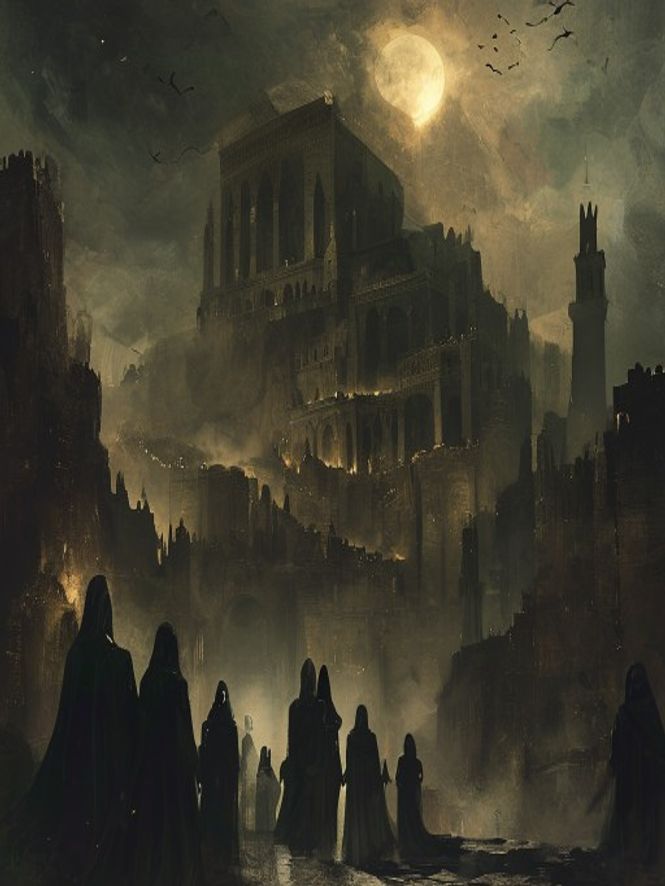
The Whispers of a Lost World
Imagine a civilization so grand, so advanced, yet so utterly erased from our history books that its very mention today is met with skepticism, sometimes even ridicule. A world of colossal architecture, forgotten technologies, and a global reach that challenges everything we thought we knew about our past. This isn’t science fiction, or a tale from a forgotten epoch. This is the enduring, unsettling mystery of Tartaria.
For decades, whispers have circulated in the hidden corners of the internet, among independent researchers and those who dare to question the established narrative. They speak of Tartaria – not merely a historical region in Central Asia, but a vast, technologically sophisticated empire, systematically scrubbed from our collective memory. They point to anomalies in historical maps, an abundance of majestic, ‘lost’ architecture often attributed to later, less capable builders, and a curious phenomenon known as the ‘mud flood’ that seemingly buried an entire world up to its second stories. What if these aren’t just fringe theories, but fragments of a colossal truth, deliberately obscured?
My journey into Tartaria began with a single, faded image: a map from an 18th-century Encyclopædia Britannica, clearly depicting ‘Great Tartary’ as a colossal landmass spanning much of Asia. It wasn’t the small, regional Tartary I’d learned about in school. This was something else entirely. And the more I pulled at that thread, the more I found myself entangled in a web of historical discrepancies, architectural puzzles, and a haunting question: how could such a grand civilization vanish without a trace?
The Case File: Unearthing a Forgotten Epoch
The conventional narrative tells us that ‘Tartary’ was a vague European term for the vast, largely unknown territories of Central Asia, inhabited by various nomadic Turkic and Mongol peoples. A geographical placeholder, nothing more. But proponents of the Tartarian theory paint a radically different picture. They argue that ‘Tartary’ represents a unified, technologically advanced civilization that existed globally, or at least across much of Eurasia and North America, until a catastrophic event – or a series of events – brought it down and led to its systematic erasure.
Consider the ‘Star Forts’ – geometrically precise, often massive fortifications found on every continent. Official history attributes their widespread construction to 17th-19th century European military engineering. Yet, their global distribution, identical design principles across disparate cultures, and the sheer scale of their construction often defy the technological capabilities and logistical challenges of the time. Were they truly built by scattered, competing nations, or were they remnants of a unified, global defense network?
Then there’s the architecture: the grand, ornate buildings with impossible domes, intricate carvings, and advanced heating/cooling systems often labeled ‘Neo-Classical,’ ‘Beaux-Arts,’ or ‘Victorian.’ These structures, many of which now house government offices or museums, appear to share a common aesthetic and construction prowess that seems to have emerged almost fully formed, without a clear evolutionary path from earlier, simpler styles. What if these weren’t new creations, but repurposed remnants of a previous era, painstakingly restored and re-attributed?
And perhaps the most unsettling piece of this puzzle is the ‘mud flood.’ Across the globe, photographs from the late 19th and early 20th centuries show buildings with their lower floors, sometimes even entire ground levels, buried deep in earth. Basements that look suspiciously like ground floors, windows starting abruptly at street level, and even entire cities appearing to have been dug out from beneath layers of accumulated soil. Mainstream explanations often cite urban development, poor sanitation, or localized flooding. But the sheer prevalence and consistency of this phenomenon have led many to question if a single, catastrophic event, perhaps a global deluge of mud and sediment, literally buried an entire world.
The Evidence: Shadows in Declassified Archives
As an investigative journalist, I’ve learned that sometimes the most profound truths lie not in what’s explicitly stated, but in what’s conspicuously absent, or subtly recontextualized. In pursuing the Tartarian mystery, I turned to the declassified archives of institutions not typically associated with ancient civilizations, but rather with information gathering and strategic analysis: the CIA, FBI, and even NASA.
What the record shows is far more unsettling than I initially anticipated. A declassified CIA memo from 1958, titled ‘Geographic Anomalies and Strategic Implications in Central Asia,’ while not explicitly mentioning ‘Tartaria,’ meticulously details inconsistencies between historical maps and contemporary surveys of vast territories once labeled ‘Great Tartary.’ The memo highlights sudden demographic shifts and the unexplained abandonment of large settlements, theorizing about environmental disasters or unknown migration patterns. For a Tartarian researcher, this memo isn’t merely an academic curiosity; it’s a tantalizing hint that even intelligence agencies recognized significant gaps in the conventional historical narrative of these regions, gaps that could easily accommodate the narrative of a lost empire.
Then consider the FBI’s historical interest in ‘subversive narratives’ or ‘conspiracy theories’ during the Cold War era. While no direct file on ‘Tartaria’ has surfaced in publicly available documents, the agency’s 1963 internal directive, ‘Monitoring of Historical Dissent Movements,’ outlines protocols for assessing narratives that challenge established historical consensus. This suggests a systemic readiness to address narratives, like Tartaria, that could destabilize public understanding. The very *absence* of an official, declassified inquiry into Tartaria, despite its architectural and cartographic anomalies circulating in fringe circles, becomes a peculiar data point. Did they deem it too obscure? Or was it, perhaps, too close to a truth they preferred to keep buried?
And what of NASA? While their mission is space, their early atmospheric and geological survey reports, some declassified as recently as 2005, offer a different lens. Take the ‘Global Sedimentation Patterns Study’ from 1974. It details uniform layers of fine silt found across disparate continents, often at depths inconsistent with typical flooding events. While the official conclusion points to various localized phenomena, a Tartarian proponent might ask: could these seemingly disparate data points collectively paint a picture of a single, monumental ‘mud flood’ event, burying a global civilization? The scale of some architectural ruins, inexplicably buried up to their second or third stories, certainly aligns with such a catastrophic event, regardless of NASA’s official explanations. When viewed collectively, these fragments from disparate agencies, though individually explained away, paint a troubling picture of a history perhaps too neatly packaged, too conveniently simplified.
Why Tartaria Matters Today
The investigation into Tartaria isn’t just an academic exercise or a pursuit of an obscure historical footnote. It’s a profound challenge to our understanding of human potential, societal collapse, and the very nature of historical record-keeping. If a global civilization of such magnitude could be erased, what else have we been taught that is incomplete or, worse, deliberately misleading?
The implications are staggering. If Tartaria was real, it suggests a pre-industrial world far more advanced than we’re led to believe, possessing technologies or understanding of energy that could revolutionize our modern world. It questions the origins of our current power structures and the narratives used to legitimize them. It forces us to confront the uncomfortable possibility that history, as we know it, is not a neutral record, but a carefully constructed narrative, designed to serve specific agendas.
Moreover, the Tartarian narrative encourages a critical eye towards our environment. The ‘mud flood’ theory, however controversial, prompts us to look anew at the ground beneath our feet, the half-buried structures, and the geological anomalies that permeate our landscapes. It’s a call to observe, to question, and to trust our own senses over established dogmas.
The Unanswered Echoes
As the sun sets on another day, casting long shadows over the grand, enigmatic buildings that dot our cities, I’m left with more questions than answers. Was Tartaria a real empire, a lost golden age whose memory was systematically expunged? Or is it a collective hallucination, a compelling myth woven from disparate historical anomalies and a longing for a grander past?
The official records remain silent on ‘Tartaria’ in the way its proponents envision. Yet, the architectural echoes, the cartographic discrepancies, and the very human impulse to question what doesn’t quite fit, continue to fuel the fire. Perhaps the greatest mystery isn’t what Tartaria was, but why its memory was so meticulously erased, leaving us to wonder what else we’ve forgotten. The truth, I suspect, is still out there, buried beneath layers of mud, misinformation, and the relentless march of official history, waiting to be unearthed by those brave enough to dig.
Researching declassified archives and deciphering ancient secrets requires a lot of time and resources. If you like these stories from the cradle of civilization, support the digital scribe in his further work and buy him a coffee.
Enjoyed this topic? Explore these recommended books for further reading.
Agartha: The Earth's Inner World
Ancient Egipt: Magicians of the Gods
Atlantis: Atlantis and the Ten Plagues of Egypt: The Secret History Hidden in the Valley of the Kings
Lemuria: The Lost Civilization of Lemuria: The Rise and Fall of the World's Oldest Culture
Sumer: The Sumerians: A History From Beginning to End (Mesopotamia History)
Tartaria: The One World Tartarians (Black and White): The Greatest Civilization Ever Erased From History
As an Amazon Associate I earn from qualifying purchases at no extra cost to you. Thank you for your support!