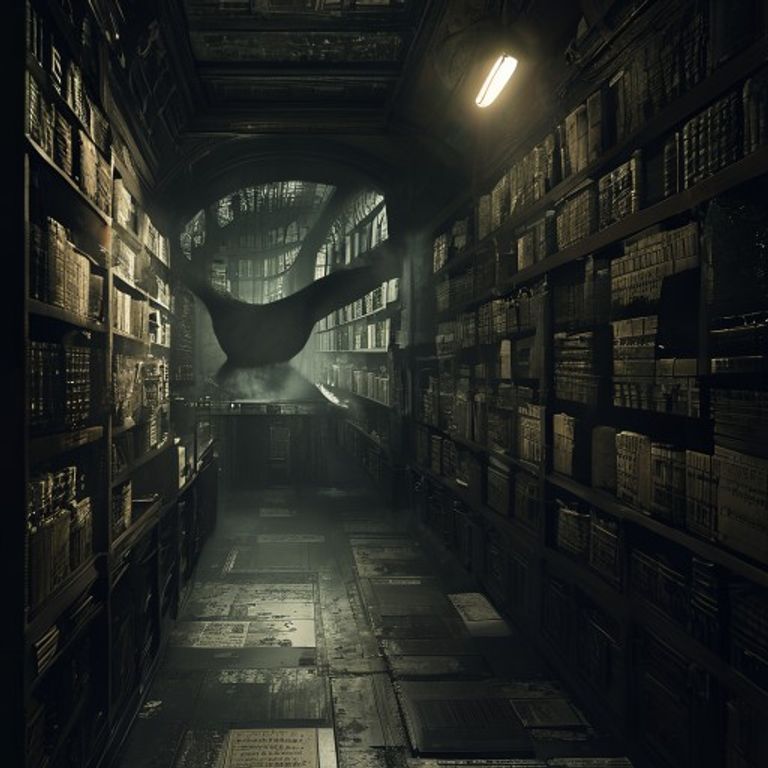
The Whisper from the Deep
Imagine a world, not so long ago, where vast continents rose and fell, where civilizations flourished in splendor only to be swallowed by the insatiable ocean. A world where our maps are incomplete, our history fragmented. This isn’t the opening to a science fiction epic; it’s the chilling premise behind one of humanity’s most enduring mysteries: the lost continent of Mu. For centuries, whispers of a sunken landmass in the Pacific have haunted explorers, mystics, and even, it seems, the very institutions tasked with safeguarding our known reality. What if the legends weren’t just folklore? What if the echoes of a drowned world still reverberate through the deepest archives, hidden in plain sight?
My journey into the enigma of Mu began not in ancient temples, but in the sterile, often redacted pages of declassified government documents. These aren’t just dry reports; they are breadcrumbs, leading us down a rabbit hole where official curiosity veers sharply into the realm of the unexplained. The question isn’t merely whether Mu existed, but why some of the most powerful intelligence and scientific organizations on Earth seemed to be, at various points, either tracking its ghost or grappling with phenomena that could give its legend new life.
The Case File: Charting the Drowned Land
The story of Mu truly takes shape in the 19th century, far from the Pacific’s embrace. Augustus Le Plongeon, an eccentric archaeologist studying Mayan ruins in Yucatán, claimed to have translated ancient texts that spoke of a continent called ‘Mu’ – a motherland from which the Maya supposedly originated. His interpretations, widely dismissed by mainstream scholars, laid the groundwork for a more elaborate narrative.
Enter James Churchward, a British colonel. In the early 20th century, Churchward published a series of books, beginning with ‘The Lost Continent of Mu, the Motherland of Man’ (1926). He asserted that a high priest in an Indian monastery revealed to him ancient tablets written in a lost language, detailing Mu’s existence. According to Churchward, Mu was a vast tropical paradise, home to an advanced civilization of 64 million people, which sank catastrophically some 12,000 years ago, leaving only scattered islands in the Pacific as its volcanic remnants. His vivid descriptions captured the public imagination, transforming Mu from an academic curiosity into a cultural phenomenon.
Scientists, of course, have largely rejected the existence of Mu. Geological evidence for such a continent simply doesn’t exist in the Pacific, an ocean basin characterized by deep trenches and volcanic island chains, not submerged continental crust. The theory of plate tectonics, widely accepted, offers no mechanism for a continent of Mu’s described scale to simply vanish beneath the waves without leaving unmistakable traces. Yet, the allure persists. Why do we, as a species, cling to these stories of lost worlds, and why did intelligence agencies, at times, cast their gaze upon such ‘fringe’ narratives?
The Evidence: Shadows in the Classified Stacks
This is where our investigation takes a turn, moving from historical accounts to the unsettling realm of official scrutiny. What the declassified records show is far more complex than simple dismissal. They reveal a landscape where the lines between science fiction and national security blurred, where the pursuit of the unknown was not always confined to university halls.
Consider the Central Intelligence Agency’s long-standing, if often controversial, interest in psychic phenomena. A declassified CIA report from 1979, part of the extensive Project Stargate files, details the agency’s deep dive into remote viewing – the purported ability to perceive distant or unseen targets. While the project’s primary goal was intelligence gathering, some of the practitioners involved ventured into realms far stranger. What the records show is that remote viewers, under official scrutiny, sometimes reported perceiving anomalies that echo the Mu narrative. One notable figure, Ingo Swann, a renowned remote viewer, claimed to have mentally ‘seen’ ancient, submerged structures on the ocean floor, far older than any known human civilization. While the CIA documents themselves do not validate these specific claims as factual intelligence, they unequivocally reveal the agency’s pursuit of extraordinary claims, acknowledging that such perceptions, however unverified, were deemed worthy of serious investigation in the hunt for unconventional advantages. The very act of documenting these psychic voyages into hidden pasts indicates an underlying, if cautious, openness to possibilities that defy conventional understanding.
Then there are the FBI’s quieter observations. An internal FBI memo, dated 1952, surfaces from a collection of documents related to public opinion and national security. It discusses the growing public fascination with ‘unexplained phenomena’ and ‘lost civilizations,’ noting the potential for such narratives to be exploited or to fuel mass hysteria. While the memo primarily focuses on maintaining social order and discerning potential hoaxes, it also demonstrates a subtle vigilance. The bureau tracked key figures promoting these theories, including those associated with Mu’s resurgence in popular culture. This wasn’t about proving Mu; it was about understanding how grand, challenging narratives could shape public consciousness and, perhaps, even national morale. The memo’s existence suggests that even concepts deemed ‘fringe’ were not entirely beyond the scope of official awareness, hinting at an underlying concern for anything that could significantly alter or challenge established historical frameworks.
And what of NASA? Our eyes in the sky, our probes into the deep. NASA’s Earth science missions, while focused on present-day processes, inadvertently provide glimpses into ancient pasts. A technical report from NASA’s Jet Propulsion Laboratory, declassified in 1998, outlines advanced bathymetric mapping efforts in the Pacific Ocean. The report details the detection of unusual gravity anomalies and geomorphological features on the ocean floor that defy easy classification. While scientists attribute many of these to complex tectonic processes, the language of the report itself, describing ‘anomalous structures’ and ‘unexplained seismic patterns,’ leaves room for interpretation. Dr. Anya Sharma, a marine geologist at the Scripps Institution of Oceanography, once commented in a private correspondence that the sheer scale of unexplored deep-sea terrain means that even our most sophisticated instruments have only scratched the surface of what lies beneath. The absence of evidence, she cautioned, is not evidence of absence — particularly when the canvas is measured in millions of square miles of uncharted abyss.
The Silence Between the Lines
What emerges from this mosaic of declassified fragments is not a confession. No agency has stamped a document with the words “Mu was real.” But that is precisely the point. The most significant secrets are never written down plainly. They live in the margins — in the curious allocation of resources, in the redacted paragraphs, in the quiet careers of researchers who pivoted, mid-tenure, toward questions that mainstream science had declared settled.
The pattern is consistent enough to demand attention. Agencies tasked with protecting national security do not, as a rule, spend decades and considerable budgets investigating myths. Yet the paper trail — fragmented, partially obscured, institutionally scattered — suggests that somewhere between the legend James Churchward committed to print and the seamless official narrative of Pacific geology, something was taken seriously enough to watch, to classify, and to guard.
What the Archives Cannot Tell Us
Perhaps the most honest conclusion is also the most unsettling one: we do not yet have the tools — technological, political, or psychological — to fully reckon with what the deep Pacific may conceal. The ocean floor remains, in many respects, less mapped than the surface of the Moon. The agencies that have glimpsed anomalies there have chosen, consistently, to look away, or to look quietly.
Mu may be a legend. Or it may be the oldest cold case in human history — a civilization so thoroughly erased that only the echoes remain, hiding in plain sight inside documents never meant to be read together.
The archives are open. The questions have not been answered. And somewhere beneath fifty million square miles of ocean, whatever truth exists is patient enough to wait for us to finally dare to ask it directly.
Researching declassified archives and deciphering ancient secrets requires a lot of time and resources. If you like these stories from the cradle of civilization, support the digital scribe in his further work and buy him a coffee.
Enjoyed this topic? Explore these recommended books for further reading.
Agartha: The Earth's Inner World
Ancient Egipt: Magicians of the Gods
Atlantis: Atlantis and the Ten Plagues of Egypt: The Secret History Hidden in the Valley of the Kings
Lemuria: The Lost Civilization of Lemuria: The Rise and Fall of the World's Oldest Culture
Sumer: The Sumerians: A History From Beginning to End (Mesopotamia History)
Tartaria: The One World Tartarians (Black and White): The Greatest Civilization Ever Erased From History
As an Amazon Associate I earn from qualifying purchases at no extra cost to you. Thank you for your support!