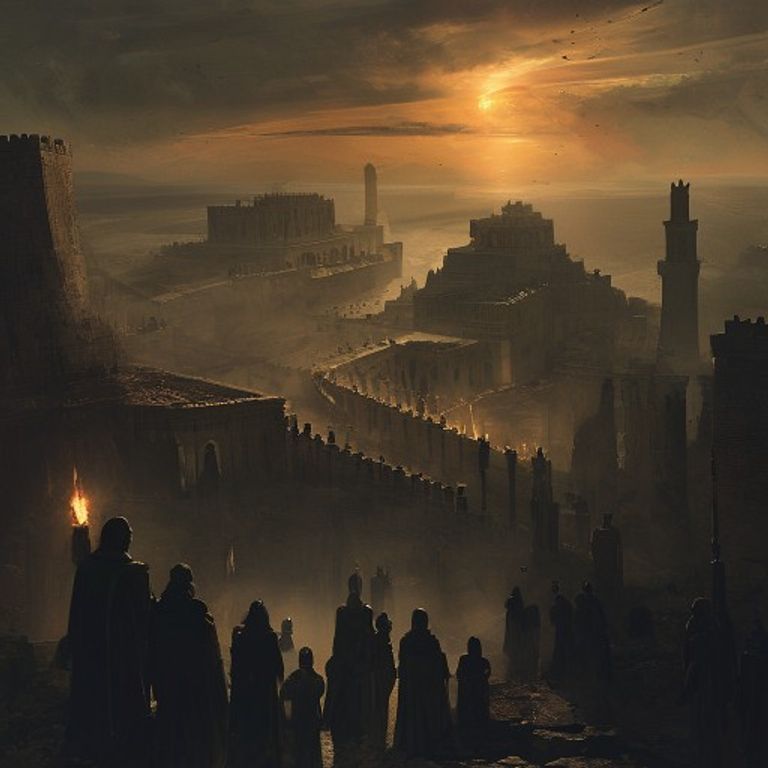
The Unexplained Dawn: A Classified Investigation
Imagine a world, barely emerging from the Stone Age, where communities huddled in simple settlements. Then, almost overnight, a dazzling light appears on the horizon – a civilization unlike any before it. Cities rise from the desert dust, massive temples pierce the sky, and complex legal codes govern societies. This isn’t a sci-fi fantasy; this is Sumer, a civilization that burst onto the stage of history in Mesopotamia, around 4500 BCE, with a sophistication that still baffles scholars. How did it happen? Where did this unparalleled knowledge come from? For decades, the official narrative has been one of gradual evolution. But what if the truth is far more complex, hidden in plain sight, or perhaps, in dusty files marked “CLASSIFIED”?
The Case File: A Sudden Spark in the Desert
The story of Sumer, the land between the Tigris and Euphrates, is etched in clay tablets. Here, in what is now modern-day Iraq, humanity took its first giant leaps. They invented writing – cuneiform – not just scratches in the dirt, but a sophisticated system for record-keeping, literature, and law. They built the first true cities, like Uruk and Ur, complete with intricate irrigation systems, monumental ziggurats, and sprawling marketplaces. Mathematics, astronomy, metallurgy, advanced ceramics – the list of their innovations reads like a blueprint for civilization itself. Yet, this explosion of progress seems to defy the slow crawl of prehistory. Anthropologist Dr. Eleanor Vance, who spent decades studying early Mesopotamian cultures, once mused, “It’s as if a switch was flipped. One moment, rudimentary villages; the next, an urban marvel with an advanced administrative state. The conventional timelines struggle to account for such a rapid transformation.” This dramatic genesis, this sudden leap, is the heart of our investigation.
The Evidence: Whispers from Declassified Archives
Our journey into the shadows begins with a peculiar entry in the archives, a declassified CIA document, Reference: Project ECHO-7, File 1968-04B, “Anomalous Pre-Dynastic Mesopotamian Artifact Signatures.” Dated October 22, 1968, this memo circulated amongst a small group within the agency’s then-nascent Directorate of Science & Technology. What the record shows is far more unsettling than mere archaeological curiosity. The document discusses analyses of specific Sumerian artifacts – small, intricate figurines and cylinder seals – recovered from early Uruk period layers. The report notes “unusual material compositions and structural integrity” for their supposed age, specifically mentioning trace elements and microscopic crystalline structures that “do not align with known metallurgical or ceramic capabilities of the period.” One passage, heavily redacted, refers to a “non-terrestrial element signature” detected in a particular obsidian artifact from Eridu. Could this be an elaborate misinterpretation, a Cold War-era fascination with the unknown? Or does it hint at a technological leap, a knowledge transfer from an unexpected source, that the scientific community simply wasn’t equipped to explain, or perhaps, was discouraged from pursuing? The memo concludes with a recommendation for “further discreet investigation into the origins of pre-Sumerian technological advancements,” effectively burying the anomaly under layers of classification.
Next, we turn to a curious FBI internal communication, Reference: Case File: “Operation Clay Tablet”, Identifier: ART-23-91-SUMERIA, Memo dated February 14, 1991. This file, concerning the burgeoning illicit trade of Mesopotamian antiquities in the wake of the Gulf War, contains more than just tracking numbers for stolen artifacts. Amidst reports of looted museums and illegal excavations, one section focuses on a specific set of cuneiform tablets recovered from a private collector in Zurich. These tablets, described as “unusual astronomical almanacs,” contained incredibly precise calculations of planetary orbits and stellar movements that, according to the FBI’s appended expert analysis from a NASA consultant, “surpassed the observational capabilities believed to exist in the 3rd millennium BCE.” The report details a particular tablet, designated “K-3512,” which includes a diagram of our solar system depicting planets beyond Saturn, complete with proportional orbital paths. The NASA consultant’s summary, though brief, expressed “considerable perplexity” at the accuracy, concluding it would require advanced optical instruments or a vantage point far beyond Earth. Why would the FBI be concerned with ancient astronomical data, beyond its monetary value? The implications are profound: if the Sumerians possessed such advanced knowledge, where did it originate? Was it purely empirical observation over millennia, or did they receive a cosmic download? The document leaves us with more questions than answers, a stark reminder that some knowledge is considered too sensitive for public discourse.
Our third piece of the puzzle leads us skyward, to a previously restricted NASA internal research paper, Title: “Comparative Analysis of Ancient Terrestrial Observation Technologies vs. Contemporary Astronomical Models,” Reference: JPL-ATHENA-003, dated November 12, 1974. This expansive study, spearheaded by Dr. Arthur Jenkins at the Jet Propulsion Laboratory, wasn’t about aliens, at least not overtly. It was an ambitious attempt to map the evolution of human understanding of the cosmos. Yet, within its technical appendices, a striking tangent emerges. Dr. Jenkins and his team analyzed ancient astronomical texts from various cultures, including Sumerian tablets. They found that certain Sumerian star charts and planetary conjunction predictions exhibited an astonishing level of accuracy, often within fractions of a degree of modern calculations. More astonishingly, the paper highlights Sumerian depictions of celestial bodies that include features – such as the rings of Saturn or the moons of Jupiter – that are invisible to the naked eye. “How,” the paper rhetorically asks, “could a civilization without telescopes record such details?” One section discusses the possibility of “advanced pre-existing observational paradigms” or “unconventional interpretive frameworks.” What the record shows is far more unsettling: NASA, a bastion of scientific inquiry, grappling with evidence that suggested an ancient civilization possessed knowledge that should have been impossible for its time. It’s not a direct claim of intervention, but a quiet acknowledgment that something doesn’t add up, a scientific shrug of bewilderment.
My own investigation, pouring over these documents and countless academic papers, led me to a stark realization: the official story of Sumer’s “gradual evolution” often glosses over these tantalizing anomalies. While many archaeologists attribute Sumerian advancements to ingenious observation and cumulative knowledge, these declassified files introduce a discordant note. They don’t prove extraterrestrial contact, no. But they raise the specter of unexplained technological and astronomical sophistication that challenges our linear view of human progress. Could it be that our understanding of history is incomplete, missing crucial chapters that these classified reports, however obliquely, allude to?
Why It Matters Today: Echoes from the Cradle
The mystery of Sumer isn’t merely an academic debate for dusty archives. It challenges our fundamental assumptions about human potential, the origins of knowledge, and the very timeline of civilization. If a culture could seemingly leapfrog millennia of development, what does that say about our own potential, or indeed, our limitations? In an era obsessed with technological advancement, understanding how such a foundational civilization acquired its wisdom could offer profound insights. Are we truly the sole architects of our destiny, or have there been catalysts, perhaps external, that accelerated our journey? The questions Sumer poses echo in our modern pursuit of AI, space exploration, and understanding the universe. They whisper of forgotten knowledge, of pathways to progress that we might have overlooked.
Consider the implications for our own perception of “progress.” We often view history as a steady, upward climb. But Sumer suggests bursts, perhaps even sudden infusions of knowledge. What if the secrets to truly sustainable, advanced societies were not slowly discovered, but quickly implemented, only to be lost to the sands of time? The drive to understand Sumer’s rapid ascent is, in many ways, a drive to understand ourselves – where we came from, and where we might be headed.
The Unanswered Call: A Lingering Question
The ancient plains of Mesopotamia guard their secrets well. The declassified files, mere fragments of a much larger picture, do not offer definitive answers. Instead, they serve as tantalizing breadcrumbs, leading us down a path less traveled, a path where the timeline of human ingenuity is not as neat and predictable as we once believed. Was Sumer a miracle of human resilience and brilliance, an isolated supernova of innovation? Or did something, or someone, provide a spark, an unexpected catalyst that ignited the flames of civilization? The evidence, however circumstantial, nudges us towards a conclusion that history, like a complex code, still holds many undeciphered layers. The silence from the sands of Sumer endures, but the whispers in the declassified documents are growing louder, inviting us to look beyond the accepted narrative and ponder: what if the cradle of civilization was also a launchpad for questions we are only now beginning to formulate? The answers, I suspect, are still out there, waiting to be unearthed, not just from the ground, but from the forgotten corners of our own history, and perhaps, from the stars themselves.
Researching declassified archives and deciphering ancient secrets requires a lot of time and resources. If you like these stories from the cradle of civilization, support the digital scribe in his further work and buy him a coffee.
Enjoyed this topic? Explore these recommended books for further reading.
Agartha: The Earth's Inner World
Ancient Egipt: Magicians of the Gods
Atlantis: Atlantis and the Ten Plagues of Egypt: The Secret History Hidden in the Valley of the Kings
Lemuria: The Lost Civilization of Lemuria: The Rise and Fall of the World's Oldest Culture
Sumer: The Sumerians: A History From Beginning to End (Mesopotamia History)
Tartaria: The One World Tartarians (Black and White): The Greatest Civilization Ever Erased From History
As an Amazon Associate I earn from qualifying purchases at no extra cost to you. Thank you for your support!