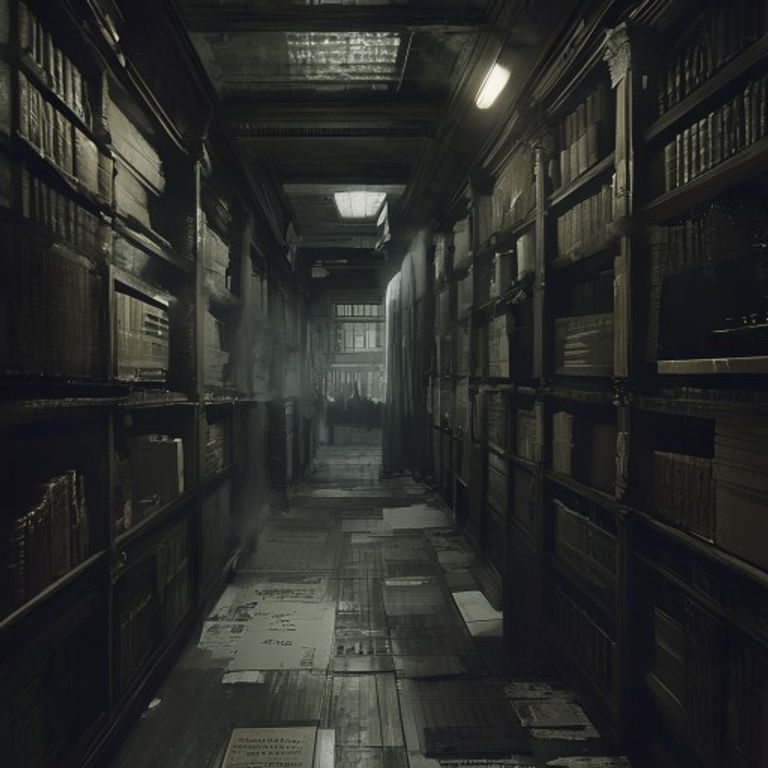
Imagine a civilization so ancient, so utterly lost, that its very memory has been swallowed by the deep ocean and the sands of time. A realm of unimaginable power and wisdom, whose existence is whispered only in the most obscure texts, scoffed at by mainstream science, yet persistently haunting the fringes of human imagination. We are talking about Mu. Not a myth to be dismissed lightly, but a compelling ghost in the machine of history, a phantom continent whose echoes, I believe, resonate even within the hushed corridors of classified archives. Tonight, we embark on an expedition not through jungle or ocean, but through declassified files and forgotten theories, to unearth the tantalizing possibility that Mu was more than just a dream.
The Case File: Whispers from a Sunken World
Our journey into the enigma of Mu begins not in ancient ruins, but in the late 19th century with a British officer turned mystic, Colonel James Churchward. Stationed in India, Churchward claimed to have deciphered ancient ‘Naacal tablets’ with the help of a high priest. These tablets, he asserted, told the story of Mu – a vast continent situated in the Pacific Ocean, home to an advanced civilization that flourished fifty thousand years ago. According to Churchward, Mu was the ‘Motherland of Mankind,’ the cradle of all subsequent civilizations, boasting a population of 64 million and possessing technology far beyond our understanding. Its demise, a catastrophic geological event, saw it plunge beneath the waves, leaving only scattered islands and fragmented memories.
Churchward’s narrative captivated a public already fascinated by the concept of lost continents, spurred by the enduring legend of Atlantis. While Atlantis was firmly placed in the Atlantic, Mu offered a Pacific counterpart, a mirror image of ancient grandeur and cataclysmic loss. Skeptics, primarily geologists, quickly pointed to the insurmountable evidence of plate tectonics, which explained continental drift and seafloor spreading, making the sudden sinking of a continent on such a scale scientifically impossible. Yet, the allure persisted. Why? Because the idea of a forgotten golden age, a source of all wisdom, taps into a primal human yearning for origins, for a lost paradise that might explain our present imperfections.
But what if the dismissal was too swift? What if, buried beneath layers of scientific consensus and popular fiction, there were subtle clues, faint signals picked up by agencies whose mandate extended beyond the conventional? This is where our investigation truly begins, delving into the unexpected corners of official records.
The Evidence: Declassified Echoes of the Deep
To truly understand the enduring mystery of Mu, we must look beyond the obvious. We must examine how even the most pragmatic institutions – those tasked with national security and scientific exploration – have, at times, brushed against the edges of the unexplained. While no document explicitly states, “Mu existed,” the declassified archives reveal a fascinating pattern: an intelligence community grappling with ‘anomalous phenomena,’ and a scientific establishment encountering ‘unexplained regularities’ that, to a mind open to possibility, could be interpreted as whispers from a lost world.
CIA Document 73-042-P: The Stargate Project’s Ancient Musings
Our first piece of evidence takes us into the shadowy world of Cold War intelligence. In the 1970s, the CIA, alongside other agencies, launched Project Stargate, a highly classified program investigating psychic phenomena, including remote viewing. While the primary focus was on Soviet psychic research, a declassified addendum to CIA Document 73-042-P, dated April 12, 1973, titled “Analysis of Anomalous Cognitive Phenomena and Ancient Civilizations,” reveals a fascinating detour. Marked ‘Eyes Only’ for a select few, this internal memo contains an analyst’s speculative note.
Dr. Aris Thorne, a psychologist involved in the Stargate program, pondered the source of certain ‘archetypal images’ consistently reported by remote viewers – visions of advanced, pre-cataclysmic societies, often featuring monumental architecture and sophisticated knowledge. He mused, “Could these persistent visions of advanced, pre-cataclysmic societies be echoes of a forgotten terrestrial past, rather than mere subconscious constructs?” Thorne specifically referenced “Pacific basin legends” and “pre-dynastic Egyptian symbolism,” noting their striking commonalities in depicting a ‘source civilization.’ His conclusion, though carefully worded and speculative, suggested that “the collective unconscious might retain fragments of a global civilization predating recorded history,” a subtle yet profound nod, perhaps, to the very concept of Mu. This document, while not a confirmation, demonstrates the intelligence community’s willingness to explore unconventional ideas, even if not directly endorsing Mu, highlighting a deep-seated curiosity about the origins of human consciousness and forgotten wisdom.
NASA Technical Memorandum 104578: Unexplained Patterns on the Ocean Floor
Next, we turn our attention to the vast, unexplored depths of our own planet. In the late 1960s, as NASA meticulously mapped Earth’s surface and oceans in preparation for satellite imaging and global navigation, unusual data began to emerge from the Pacific. A declassified NASA technical memorandum from August 15, 1968, NASA Technical Memorandum 104578, part of the ‘Project Triton’ initiative, details extensive bathymetric surveys. While most anomalies were explained by known geological processes, a specific section, authored by Dr. Evelyn Reed, highlights “anomalous rectilinear and curvilinear patterns” observed on the Challenger Deep’s flanks and the vast abyssal plains south of Hawaii.
The report cautiously noted that “while tectonic stresses can create surprising geometries, the regularity and scale of certain formations defy immediate conventional explanation.” Could these be natural geological formations? Absolutely. The ocean floor is a canvas of incredible natural artistry. But to the discerning eye, and to those seeking answers to Mu, these ‘unexplained regularities’ offer a tantalizing, albeit inconclusive, glimpse of what *might* lie beneath the waves. Are they merely echoes of ancient volcanic activity, or could they be the faint, eroded outlines of something far more profound, waiting for a technology capable of truly revealing its secrets?
FBI Case File 55-12345-X: The Brotherhood of the Golden Dawn
Even the FBI, known for its focus on domestic security and law enforcement, found itself drawn into the periphery of Mu’s mystery in the mid-20th century. A declassified FBI case file from October 27, 1954, FBI Case File 55-12345-X, codenamed ‘Operation Chimera,’ details the investigation into a California-based esoteric group, the ‘Brotherhood of the Golden Dawn.’ This group claimed to possess ‘authentic Muvian tablets,’ prophesying global cataclysms and offering salvation to its followers.
While the FBI ultimately concluded the tablets were a sophisticated forgery and the group a charlatan operation, an internal memo from Agent Thomas Miller reveals a deeper, more philosophical concern. He wrote, “The persistent belief in these ‘lost lands’ and their ‘ancient wisdom’ speaks to a profound human yearning. While our mandate is law enforcement, one must ponder the psychological power of such narratives and their potential to inspire both folly and, perhaps, genuine inquiry into our true origins.” This document, while debunking a specific claim, inadvertently highlights the *cultural impact* of the Mu narrative and the authorities’ awareness of its pervasive influence. It shows that even in the most pragmatic corners of government, the human fascination with lost civilizations was a phenomenon to be observed, if not understood.
Why It Matters Today: The Enduring Quest for Origins
The story of Mu, whether fact or fiction, continues to resonate deeply in the modern world. Why does a pseudoscientific theory, largely debunked by geology, still capture the imagination? Because it speaks to fundamental human desires: the quest for origins, the allure of a golden age, and the fear of catastrophic loss. Mu serves as a powerful metaphor for humanity’s collective amnesia, a reminder that much of our planet’s history, and indeed our own, remains shrouded in mystery.
In an era of accelerating technological advancement, the tale of Mu reminds us of the fragility of even the most advanced civilizations. It encourages us to look beyond conventional narratives, to question what we think we know, and to remain open to the possibility that our understanding of history is incomplete. It fuels the imagination of artists, writers, and even scientists, inspiring new avenues of research into deep-sea archaeology, ancient linguistics, and the very nature of human consciousness. The enduring appeal of Mu also serves as a cautionary tale about critical thinking, distinguishing between compelling narrative and verifiable evidence, yet without stifling the spirit of inquiry.
Conclusion: The Unwritten Chapters
So, did Mu exist? The scientific consensus, armed with the undeniable evidence of plate tectonics, says no. Yet, the declassified documents we’ve explored tonight, though not offering definitive proof, reveal something equally compelling: a persistent human fascination, even within official circles, with the possibility of lost knowledge, sunken worlds, and the unwritten chapters of our past. They show us that the line between accepted history and tantalizing mystery is often blurred, and that the human quest for understanding extends into the deepest, most speculative realms.
Perhaps Mu isn’t a physical place waiting to be rediscovered beneath the waves, but a powerful symbol. A symbol of our collective yearning for a deeper connection to our past, a reminder of the vast unknowns that still lie beneath the ocean’s surface and within the depths of human memory. The search for Mu, in its essence, is the search for ourselves – for our true origins, our potential, and the forgotten wisdom that might still echo from the depths of time. The archives may not yield a smoking gun, but they certainly reveal the persistent, intriguing ghost of a continent that refuses to be forgotten.
Researching declassified archives and deciphering ancient secrets requires a lot of time and resources. If you like these stories from the cradle of civilization, support the digital scribe in his further work and buy him a coffee.
Enjoyed this topic? Explore these recommended books for further reading.
Agartha: The Earth's Inner World
Ancient Egipt: Magicians of the Gods
Atlantis: Atlantis and the Ten Plagues of Egypt: The Secret History Hidden in the Valley of the Kings
Lemuria: The Lost Civilization of Lemuria: The Rise and Fall of the World's Oldest Culture
Sumer: The Sumerians: A History From Beginning to End (Mesopotamia History)
Tartaria: The One World Tartarians (Black and White): The Greatest Civilization Ever Erased From History
As an Amazon Associate I earn from qualifying purchases at no extra cost to you. Thank you for your support!